
Political science (BA major)
Admissions
Learn everything you need to know about becoming a UVic student, from choosing a program and reviewing admission requirements to submitting your application and reporting your grades.
If you have questions, talk to a student recruiter or attend one of our events.
Courses
You’ll need to complete 9,0 units of political science courses at the 100- and 200-levels and 15 units of political science courses at the 300- or 400-level to earn a major in political science.
Honours program
The honours program helps students develop skills designed for graduate school or for writing/research intensive careers. You will be part of a close-knit student cohort and work closely with a faculty supervisor on your honours thesis.
Admission to the honours program requires a GPA of 6.0 in at least 7.5 units of political science courses numbered at the 100- or 200-level. We recommend that students take a broad range of political science courses including at least one on Canadian politics, one on comparative politics, one on international politics and one on political theory.
If you're interested in pursuing an honours degree, contact the Honours Advisor, Dr. Scott Watson, before your third year.
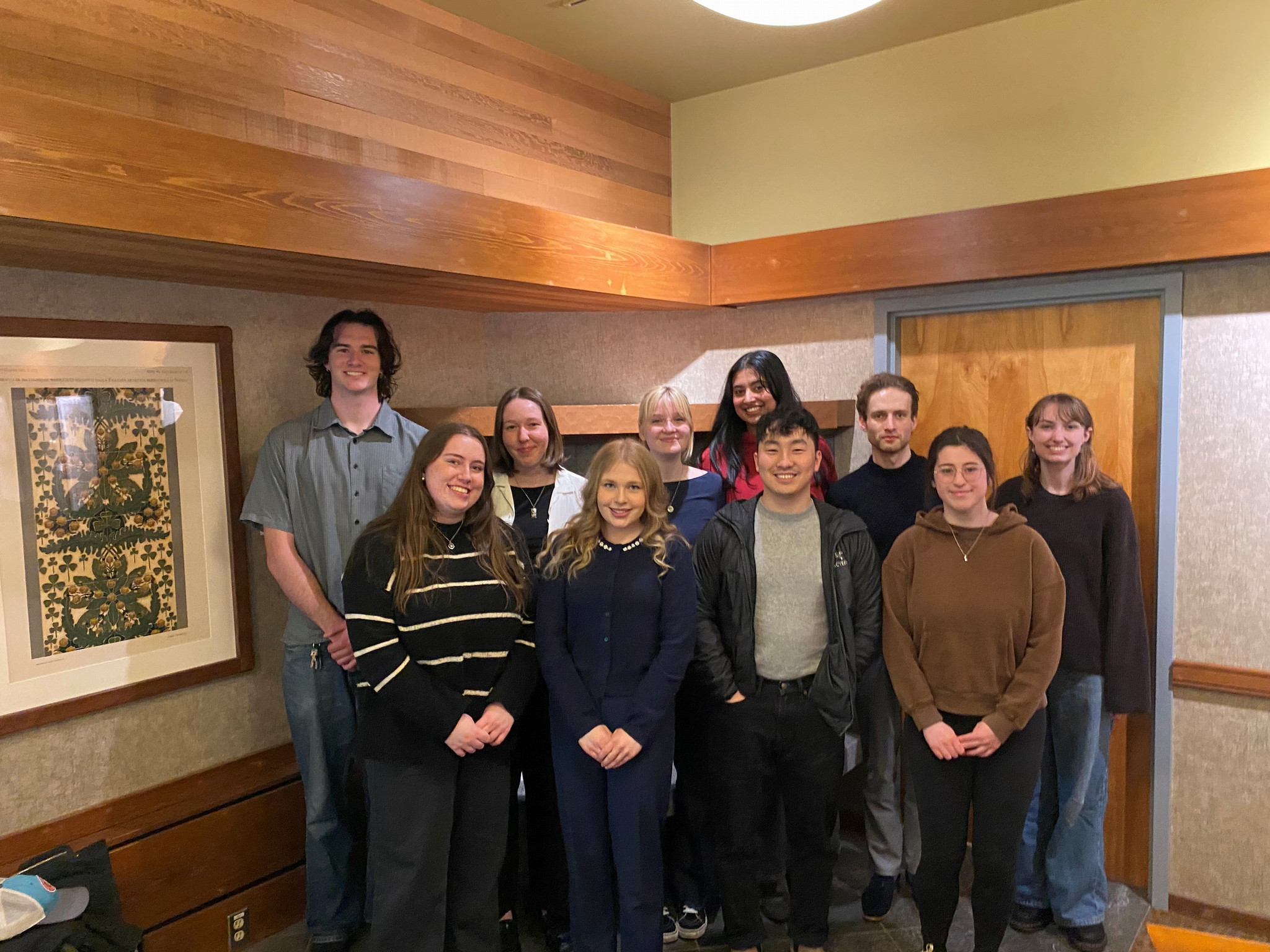
Congratulations to our 2026 Honours students!
Lena Arlt-Dufresne, "Responses to Gender-Based Violence: The Fluctuations of Two French Social Movements" Committee: Marlea Clarke (supervisor), Michelle Bonner (second)
Elliott Baxendale Fabi, “The Oikos and the Problem of Exile: Oikos, from Aristotle to Scruton, as a Post-Development Framework" Committee: Andrew Wender (supervisor), Mara Marin (second)
Kaya Dupuis, "Arming Germany in a Post-U.S. NATO World" Committee: Scott Watson (supervisor), Colin Chia (second)
Natasha Heywood, "The Treaty Road Left Untravelled: An Analysis of Treaty-Making in British Columbia Post 1854" Committee: Justin Leifso (supervisor), Jamie Lawson (second)
Jordyn Kramer, "Gatekeepers of Global Money: Understanding State Policy Choices on Remittance Inflows" Committee: Colin Chia (supervisor), Andrew Wender (second)
Aidan MacAuley, "Smoke and Mirrors: Histories and Policy Regimes of British Columbia’s Wildfire Governance Paradigm" Committee: Jamie Lawson (supervisor), Justin Leifso (second)
Grace MacMaster, "Ontologies as Deep Leverage Points: How Understandings of Interconnectedness Impact Productive Organization, with Implications for the Ecological Crisis" Committee: Simon Glezos (supervisor), Mara Marin (second)
Kali McWhinnie, "Champions of Freedom in Canada: Right-Wing Nationalism and the 2022 Convoy Protests" Committee: Michelle Bonner (supervisor), Matt James (second)
Mao Nishimura, “Defence Policy Shifts: A Comparative Analysis of Japan and Germany Government Discourse" Committee: Amy Verdun (supervisor), Feng Xu (second)
Thomas Park, “Liberator or Colonizer: The United States of America, the Republic of Korea and the Forgotten Case of Colonialism" Committee: Amy Verdun (supervisor), Marlea Clarke (second)
Ekamjot Pooni, “The Normalization of Anti-Immigration Discourse in Canadian Mainstream Media (2015-2025)" Committee: Justin Leifso (supervisor), Matt James (second)
Double major
You can pursue a double major of political science in combination with other disciplines. Reasons you might want to pursue a double major:
- political science and environmental studies for a career as an environmental policy analyst
- political science and gender studies for a career in women's advocacy and policy development
- political science and economics for a career in international relations and economic development
There are a few combinations not allowed, but generally you can be creative.
Minors & specializations
A minor is an optional program that allows you to study in an area outside of your major program area. A minor in political science requires:
- 6 units of courses numbered at the 100 or 200 level
- 9 units of courses numbered at the 300 or 400 level
Minor in Global Development Studies
Study the Global South—the Asia-Pacific region, Africa and Latin America. Understand the history, theories and practices of global development. Study colonialism, global patterns of poverty and inequality, and development aid.
The interdisciplinary GDS Minor requires 12 units of coursework. You’ll take 3 units of lower-level courses and 9 units of upper-level courses.
Option in European Studies
The European Studies Option is designed for majors and honours students in political science who want to graduate with a concentration in European politics.
Opportunities include internships and study tours to the EU institutions in Brussels, exchange opportunities, West Coast Model EU and many others.
Related programs
Funding
UVic offers scholarships, bursaries, awards and other funding opportunities to help you further your education and succeed in your studies.
Political science scholarships
Most scholarships are awarded based on recommendations made by the department. However, some require a separate application form.
Awards for political science students
Our recent scholarship winners
Jamie Cassels Undergraduate Research Awards (JCURA)
The Jamie Cassels Undergraduate Research Award (JCURA) supports students who complete a research project under the mentorship of a faculty supervisor.
Full-time third and fourth year students with a GPA of 7.0 or above are eligible to apply. Each successful student receives a $1,500 credit in their UVic account.
Our recent JCURA award winners
Valerie Kuehne Undergraduate Research Awards (VKURA)
The Valerie Kuehne Undergraduate Research Award is an internship opportunity for first- and second-year students to gain research-enriched and applied experiences in their field of study. Students gain experience working within a research environment that is collaborative and collegial with direct support from a faculty mentor.
Career options
Our graduates are well-trained and learn skills in research, writing, data and policy analysis and public presentation. Political science students find work with government agencies and non-profit organizations. They also work across the private sector, in journalism and consulting. Many of our students go on to law school or graduate school.
Co-op
Our optional co-operative education (co-op) program gives you hands-on paid work experience related to what you're studying. It's the perfect way to develop your skills and find a career you love.
Learn more about what co-op is, how it works with your degree and what to expect as a co-op student.
Political Science co-op students get work experience in research, policy analysis and development, project management, community development and media/communications.
Sample jobs and employers
- BC Healthy Communities – Victoria Youth Council coordinator
- National Defence and the Canadian Forces – Geopolitical and Maritime Security research assistant
- Victoria Disability Resource Centre – workshop program coordinator
- Land Trust Alliance of BC – community outreach officer
- Parks Canada – Gulf Islands National Park Reserve survey coordinator
Questions? Contact the Political Science Co-op adviser
Hands-on learning
Legislative and Parliamentary Internship Programs
The BC Legislative Internship Program lets Canadian university graduates observe the daily workings of the Legislature first-hand and assist Members of the Legislative Assembly during the parliamentary session. The program is open to BC residents who have a recent bachelor’s degree from a Canadian university. Application deadline: January 31. For more information, contact Dr. Justin Leifso.
The Parliamentary Internship Program welcomes young professionals to Parliament Hill September-June. The paid, non-partisan interns are selected through a national competition. Parliamentary interns meet with senior policymakers, diplomats, journalists, scholars, politicians and leaders in civil society. Application deadline: January 31.
Thailand Field School
We’ve partnered on a new field school in northern Thailand examining policies of development and the environment. Read about the Thai Field School in the Ring.
The 1.5 unit, third-year level cross-listed course (POLI 391 / GDS 391) involves a week of intensive classroom study at UVic then it’s off to Thailand for 2.5 weeks of experiential learning.
This field school is unique as priority is given to students usually underrepresented in overseas opportunities. Funding covers the entire costs of the field school for up to 7 students and partial funding for another 3.
For more information about the next Thai Field School, contact Robyn Fila in the Centre for Asia Pacific Initiatives (CAPI).
Community Engaged Learning
With community-engaged learning (CEL), you'll connect course content with real-world experiences. You’ll contribute to communities and build your understanding, your CV and your network. There are over 100 opportunities for CEL in the social sciences at UVic.
Examples of CEL activities in Political Science:
- The B.C. Legislative Internship program offers first-hand experience in our parliamentary system and contribute directly to the work of the executive and legislative branches of government.
- The Model UN Club simulates UN discussions and formats. Students organize conferences in Victoria and attend the annual National Model UN conference in New York City.
To find out more about CEL opportunities in Political Science, contact celc1@uvic.ca or 250-472-5667.
Forms
Program planning worksheets