
Environmental Studies field schools
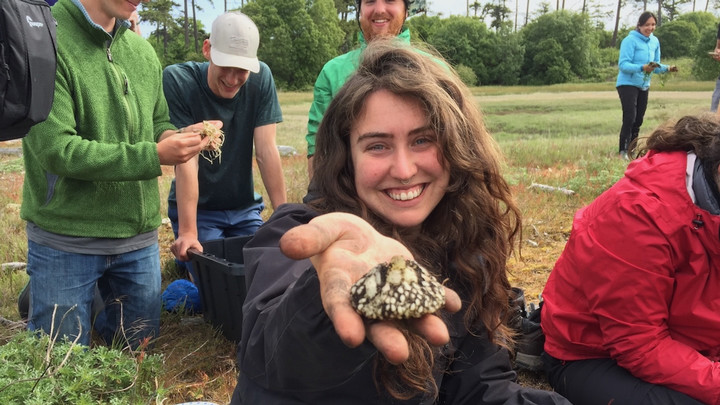
Take your learning outside of the classroom with one of our experiential field school courses! Work with community partners and knowledge-holders on islands, coastlines, farms and urban forests. You’ll build practical skills while earning upper-level credits. Field schools also count towards the experiential course requirement for an ES major.
Deadline for application is normally February 1st.
ES 2026 summer field schools
Travel to Angers France to explore the intricacies of terroir-driven food systems. Visit farms, businesses, and experts in regional and sustainable food production. This course is offered in collaboration with École Supériure d’Agricultures in Angers, France. Find out more on our web site!
Note: this field school is comprised of 2 courses (for 3.0 credits in total).
Instructor: Dr. John Volpe
Location: Angers, France
Additional course fees: approx. 2419 Euros, not including return airfare to France
Prerequisites: 2nd year standing and permission of the department
Approximate dates: May 27–June 25
Application Deadline: February 1st
Application instructions: Complete the online Field School Application Form. You’ll be asked to upload your CV and unofficial transcripts and complete a small set of questions.
Accessibility and what to expect:
Approximately one month in France, combining classroom learning with site visits and multi-day excursions in Paris, Brittany, Normandy and the Loire Valley. Students stay in a youth hostel in Paris and with host families in Angers, with other accommodation during overnight excursions. Expect group travel and changes in daily routines. Transport, meals and accommodation on course excursions are included, while students arrange travel to Paris and onward from Angers.
Things to know:
- Students arrange their own travel to Paris and onward travel from Angers.
- Coursework includes advance preparation, daily journalling and a group presentation.
- French-language classes form part of the course and assessment.
For more information please see ES 371 in the UVic calendar or reach out to the instructor.
Explore the role of traditional ecological knowledge in the understanding and documentation of the biodiversity of natural systems and their restoration. Examine how restoration strategies can benefit from the close relationship of Indigenous Peoples to their local environments, and from their knowledge of plants and animals, their habitats and ecological interrelationships, as well as from traditional land and resource management strategies.
Instructors: Loreisa Lepine
Location: In & around Victoria
Additional course fees: $135
Prerequisites: ES 200 and ES 321
Approximate dates: May 25–May 29
Application instructions: Complete the online Field School Application Form. You’ll be asked to upload your CV and unofficial transcripts and complete a small set of questions.
For more information please see ES 423 in the UVic calendar or reach out to the instructor.
Explore regenerative and restorative designs for ecological and social resilience on Galiano Island at the Galiano Learning Centre in partnership with the Galiano Conservancy Association. The course includes a field stay on Galiano Island, with some advanced preparation and follow-up work. Course is limited to 16 students.
Instructor: Dr. Eric Higgs
Location: Victoria and Galiano Island
Additional course fees: $950
Prerequisites: ES 341 or ER 311
Approximate dates: July 3–July 12
Application Deadline: February 1st
Application instructions: Complete the online Field School Application Form. You’ll be asked to upload your CV and unofficial transcripts and complete a small set of questions.
Accessibility and what to expect:
A field intensive on Galiano Island, with students camping in a grove beside the classroom building at the Millard Learning Centre. Expect many hours outdoors in variable weather, combining hands-on restoration fieldwork with seminars, team projects and some evening events. Field clothing should provide protection from rain, sun, thorns and burrs. The nearby classroom provides indoor shelter and space for meals, with students sharing meal preparation and cleanup. Travel to and from the island is by ferry; tents and sleeping pads are available to rent, potentially at additional cost. Time for outside commitments is limited.
Things to know:
- Complete preparatory reading and written work before arrival; expect limited time for other commitments during the field intensive.
- Small teams develop restoration designs for the Galiano Conservancy Association, with reports and revisions continuing after the field stay.
- Bring suitable outdoor and camping equipment. Tent and sleeping-pad rentals are an option, potentially at additional cost.
- You must make your own way to Galiano Island, which is by ferry.
For more information please see ES 471 in the UVic calendar or reach out to the instructor.
Explore the advanced practical study of permaculture principles in an intensive field-based setting at Linnaea Farm School on Cortes Island, BC. Focus will be on implementing concepts and practicing skills introduced in ES 433, while also learning from local permaculture perspectives and initiatives. 8 days course time, with two travel days. Students who successfully complete both ES 433 and ES 473 will receive a Permaculture Design Certification.
Instructor: Hannah Roessler
Location: Cortes Island
Additional course fees: approx $1400
Prerequisites: ES 433
Approximate dates: May 7–May 16
Application Deadline: February 1st
Application instructions: Complete the online Field School Application Form. You’ll be asked to upload your CV and unofficial transcripts and complete a small set of questions.
Accessibility and what to expect:
Students stay at the Linnaea Farm on Cortes Island, with visits to other island sites and hands-on learning including a market-garden work party, plant activities and natural dyeing. Teaching also explores animal care, composting, natural building and wetland restoration. The sample daily schedule begins with breakfast at 8 a.m., includes morning and afternoon sessions, and continues with evening activities until 9 p.m., with meal breaks and some free time. Earlier morning activities are optional. Students also complete individual observations, group feedback activities and a short presentation.
Things to know:
- The course builds on ES 433 and focuses on implementing and maintaining permaculture systems. Completing both courses earns you Permaculture Design Certification.
- Coursework begins before arrival and continues after departure.
- The major assignment applies permaculture design to an aspect of your own life, supported by observation, field learning and peer feedback.
- You must make your own way to Galiano Island, which is by ferry.
For more information please see ES 473 in the UVic calendar or reach out to the instructor.
Travel up Vancouver Island to Tofino, to explore the conservation situation of salmon and ways to address their decline. Meet with local practitioners to understand the changing environmental, ecological, political, and historical aspects of salmon, and how various interests in this space interact and conflict. Field activities may include visits to wild salmon rivers, conversations with harvesters and First Nations partners, and opportunities to observe fisheries management, hatchery or aquaculture operations.
Instructor: Dr. Ben Neal
Location: Tofino, BC
Additional course fees: approx $1600
Prerequisites: ES 200 and ES 341
Approximate dates: June 29-July 8
Application Deadline: February 1st
Application instructions: Complete the online Field School Application Form. You’ll be asked to upload your CV and unofficial transcripts and complete a small set of questions.
For more information please see ES 482 in the UVic calendar or reach out to the instructor.
Applications and fees
How to apply:
- Complete the online Field School Application Form by February 1st. Have your CV and unofficial transcripts ready to upload.
- Watch for a decision by email by approximately February 15th.
- Secure your seat with a 50% of non-refundable field course fee deposit by early March.
- Pay the balance of the fees depending on course dates.
What are additional course fees?
Field course fees help cover costs such as food, transport and accommodation. They are in addition to your usual course tuition fees.
Funding support:
Eligible ES students and RNS Diploma students can apply for Lorene Kennedy Field Course Awards to help offset the majority of course fees. Reimbursement is after successful completion of the course. Find out more in our FAQs below.
Field school FAQs
For most field courses, you submit an application (before the deadline) to the course instructor. Once accepted, you must formally confirm your participation by payment of an additional course fee deposit.
Some courses do not require an application (students can simply register themselves).
Please deliver payment to the Environmental Studies main office in David Turpin Building B243.
We accept cheques, bank drafts or money orders (Canadian funds only), payable to the University of Victoria.
Place your payment in a standard envelope (even if dropping off) labelled “Attention: Undergraduate Programs Assistant” and include the course name, your name and your V#.
Please use a separate cheque for each course in which you are registered.
If the main office is closed, the ES office Dropbox is located to the right of the main office door: in the top left-hand corner of the cabinet, it is boldly marked in yellow: “ES Dropbox”. It is accessible during normal building hours.
We are sorry, but cash is not accepted and we are not able to accept electronic payments. If you are unable to access cheques or order them through your bank, it is suggested that you e-transfer a family member or trusted friend who can then write and deliver a cheque to us, on your behalf.
After we receive your payment, we will email you a receipt.
If you cannot travel to campus and need to pay by mail, please note that the payment must arrive by the due date to the below address. It is helpful to notify esoffice@uvic.ca in advance, if you plan to mail in a payment.
Environmental Studies
Attention: Undergraduate Programs Assistant
University of Victoria
PO Box 1700, STN CSC
Victoria, BC V8W 2Y2
To drop, you must remove yourself from the course via the online registration portal. Please take note of drop deadlines, as these will affect tuition refunds and academic outcomes.
How do I apply?
Award application is not necessary on your part; if you qualify, your application is automatic.
Am I eligible?
Eligible students are either:
- enrolled full-time or part-time undergraduate students who are declared (BA/BSc) majors or minors in the School of Environmental Studies,
- graduate students in the School of Environmental Studies, or
- students in the Restoration of Natural Systems Diploma program.
After you have completed the course, and we have received class grades (confirmation that you have passed the course), the School will confirm if you meet the award requirements. Those who qualify will be awarded 75% of your field course fee, applied as a credit to your Tuition Fee Account.
When is the award paid out?
You will receive the award during through the term following successful course completion. E.g. if you took a Summer field course and qualified, you would receive the award money between September and December.
What if I am leaving UVic?
If this is your last term of study, you will be able to request a cheque from Accounting Services once you see the credit posted to your tuition account; please contact the Tuition Office to request this action.
Not offered this year
Explore the theory and practice of creating alternatives to the dominant order. Readings and activities include a variety of perspectives on the dominant order and efforts to resist, recover, and cultivate other relationships. Includes field visits to farms, land projects, and mentors on Denman Island. Course themes include de-institutionalizing life and learning, supporting subsistence and social reproduction, and collaborating horizontally. Course starts with 2 months of online reading, culminating in a field school on Denman Island and a community feast students plan and cook for Denman Island residents.
Instructor: Nick Montgomery
Location: Denman Island, BC
Additional course fees: approx $1600
Prerequisites: ES 200
Approximate dates: TBD
Application Deadline: February 1st
Use an ethnoecological lens to explore intersections between people and place in urban environments. Visit and work with urban agriculture, urban foraging, urban forests and green spaces in Victoria.
Instructor: Dr. Trevor Lantz - tlantz@uvic.ca
Location: on campus with day field trips approximately 5 hours each
Additional course fees: approx $150
Prerequisites: ES 200 and 3rd year standing
Approximate dates: TBD
No application necessary - register during normal summer term registration
Accessibility and what to expect:
A locally based course with substantial time outdoors in parks, gardens, neighbourhoods and stream environments, in rain or shine. Most sites can be reached by bus, bicycle or on foot; cycling is proposed for some field days, and bike-safety training is scheduled outside of class time. Classes generally run for two to four hours and may begin or finish away from campus. Field activities include observing and identifying species, measuring and mapping trees, and recording findings in a notebook. Some assignments involve additional independent or group site visits.
Things to know:
- Assessment includes individual and group assignments, a field notebook and participation, with no scheduled exams.
- Some assignments require site visits outside class and access to a computer with Excel.
Learn fundamental and advanced field skills common to ethnoecology and other field-based disciplines. Based in Victoria and on Tl’ches. Your field work contributes to collaborative research project with the Songhees Nation.
Instructor: Dr. Darcy Mathews
Location: Tl’ches, BC
Additional course fees: approx $1000
Prerequisites: 3rd year standing and at least one of ES 301, 321 or 341
Approximate dates: TBD
Application Deadline: February 1st