
Northern Europe Geography Field School
People, Planet, & Politics in the Nordic-Baltic Region
Join this travel study program traversing the Nordic-Baltic region and exploring how societies are responding to social, environmental, and political change.
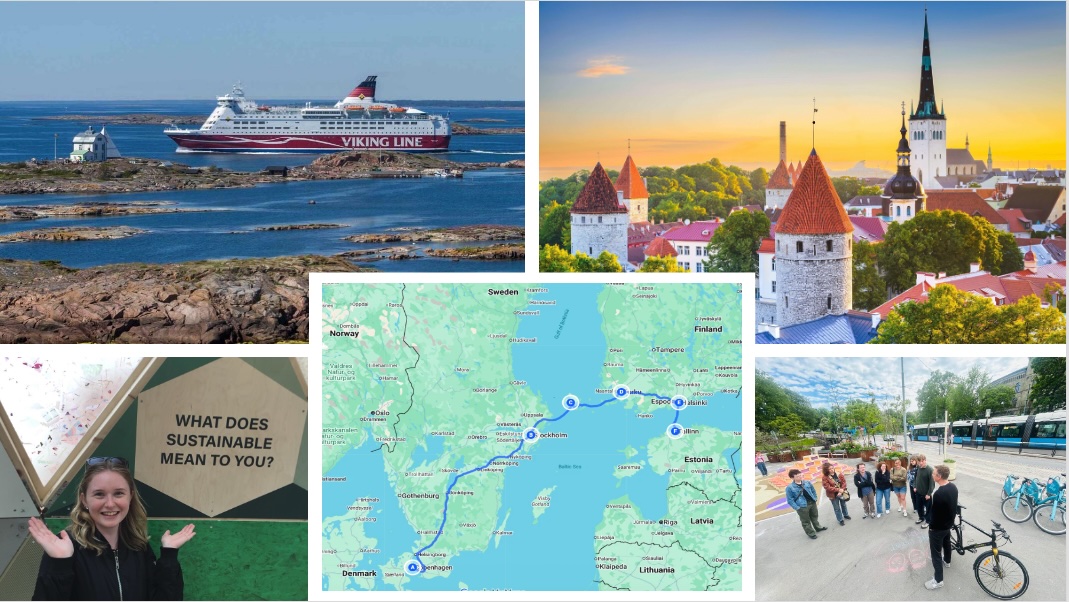
Across cities in Denmark, Sweden, Finland, and Estonia, students will explore timely issues firsthand, including urban sustainability, community resilience, the Nordic social democratic model, and changing Canada–Europe relations.
Traveling by train, bus, ferry, bike, and local transit - and staying in hostels or other clean, affordable accommodations - we will connect with urban planners, community leaders, scholars, and others engaging directly with these questions. The program will include guided field trips, hands-on workshops, and engaging discussions, while leaving plenty of time for individual exploration.
Course description
Students register in both classes. Each course is worth 1.5 credits for a total of 3 credits.
GEOG 388 – Regional Studies: Europe
Instructor: Cameron Owens
May 5 - June 3 2027
This course, delivered as part of an off-campus travel study program, focuses on the regional geography of Europe attending in an engaging, experiential way to physical, historical, cultural and political elements of the region with a focus on human/environment relationships. The course complements and must be taken in association with GEOG 317.
GEOG 317 – Field Studies in Sustainable Communities
Instructor: Cameron Owens
May 5 - June 3 2027
This course, delivered as part of an off-campus travel study program, focuses on sustainable community development. Students will learn in an engaging, experiential format about efforts to address social, economic and ecological concerns facing contemporary communities. The course complements and must be taken in association with GEOG 388.
Proposed itinerary
-
May 5-11 - Mandatory pre-departure program at UVic
-
May 12-13 - Independent travel to Copenhagen, DK
-
May 14-18 - Copenhagen, DK – Denmark’s lively capital famous for sustainable urbanism, cycling culture, design, and Nordic approaches to city life
-
May 19-22 - Stockholm, SE – Sweden’s monumental capital built on a series of islands and around the ritual of fika – coffee, pastries and slowing down; itinerary includes connecting with the famous Stockholm Resilience Institute
-
May 23 - Autonomous Republic of Åland - an autonomous Swedish-speaking archipelago of forests, rocky shores, and small island communities, offering a refreshing immersion in Baltic nature and a fascinating case of identity and governance
-
May 24-25 - Turku, FI - Finland’s oldest city and former capital, where a medieval castle, lively riverfront, student culture, and centuries of Swedish-Finnish history meet the Baltic Sea
-
May 26-30 - Helsinki, FI – Finland’s stylish seaside capital, known for bold design, public saunas, and innovative governance; itinerary includes attending the World Village Festival, a major public celebration of global justice, sustainability, culture, and civic engagement.
-
May 31–June 3 - Tallinn, EE - a city of dramatic contrasts, blending medieval walls and cobbled streets with digital innovation, Baltic identity, and Estonia’s rapid post-Soviet transformation.
-
June 4 - Travel home or onwards
Note: Tallinn has an international airport with connections to major European hubs, making it easy to return home or continue on to other popular destinations. More adventurous travelers may continue overland through the Baltic region and Central Europe.
Eligibility
You must be a UVic student who has completed your first year of study. You must be able to register in 300-level geography courses. Otherwise, you need special permission from the instructor, Cam Owens (camo@uvic.ca).
Non-geography students are invited to apply. Priority will be given to students interested in urban sustainability.
How to apply
Applications for the 2027 field school will be available here soon.
Contact geography@uvic.ca if you have any questions.
Fees
Students pay regular UVic tuition plus field school fees. Field school fees can be paid by cheque, money order or cash only. Cheques and money orders should be made payable to the University of Victoria.
Field school fees include:
- all accommodations during the travel study part of the field program
- breakfasts
- activity costs (entry admissions, guided tour and workshop fees, presenters’ fees)
- ground transportation (e.g. train, local transit, ferry, bike rentals)
- emergency contingency fund
Field school fees do not include:
- tuition
- airfare (to allow students flexibility in terms of travel plans)
- other expenses: e.g. meals (apart from breakfast), entertainment, travel insurance (if you need coverage beyond your UVSS plan)
The field school fees have been subsidized by the Faculty of Social Sciences. There may be additional funding through scholarships and financial aid or the International Centre for Students.