
UVic’s PolarLink Satellite Moves Closer to Launch
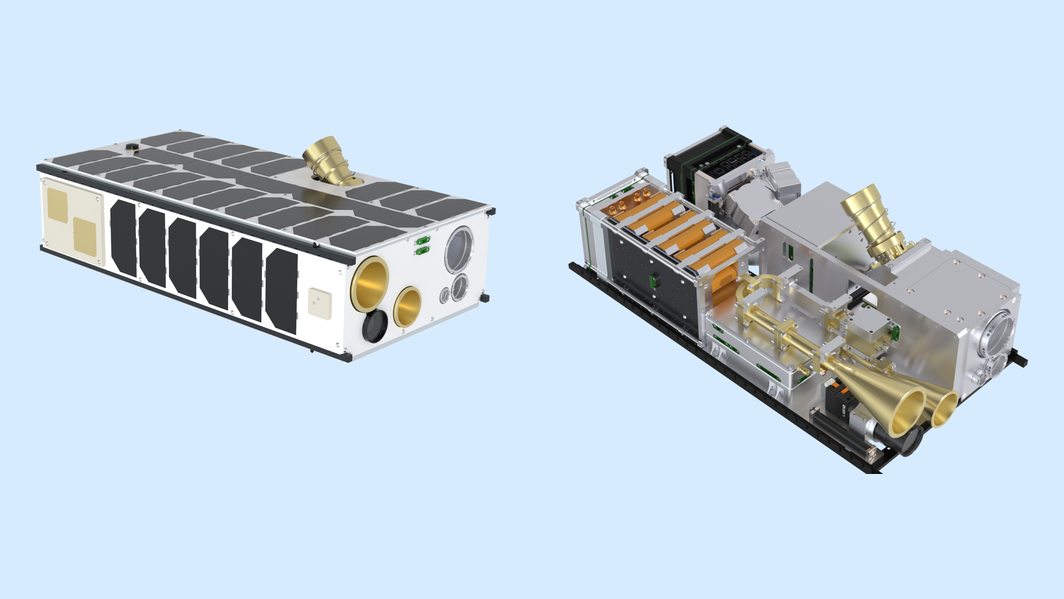
PolarLink, the newest satellite from UVic’s Centre for Aerospace Research (CfAR), has successfully passed its Critical Design Review, marking an important milestone in the mission.
The review confirms that the satellite’s detailed design is complete, clearing the way for the team to begin assembling and testing the spacecraft ahead of a planned launch in late 2027.
PolarLink is funded through a $2.82-million contract from Defence Research and Development Canada (DRDC) under the Space Low Earth Orbit (SpaceLEO) program. CfAR is one of three teams in Canada selected for the program, and the only one led by a university.
The research mission will investigate how satellites in low Earth orbit (LEO) could improve the speed, reliability, and accessibility of communications in the Arctic, where many communities and operations rely on limited or costly connectivity.
Improving satellite communications in Canada’s Arctic
For decades, satellite communications in northern Canada have relied largely on geostationary satellites, which orbit at a much greater distance from Earth. While these systems provide broad coverage, the distance creates significant delays and can contribute to high service costs. Newer commercial LEO networks, such as Starlink and OneWeb, orbit much closer to Earth and offer faster connections. However, there is still little independent research into how well these networks perform in the Arctic’s challenging conditions. PolarLink’s research will help address this gap by collecting performance data on the ground and testing emerging communications technologies in orbit.
“There’s very little independent data on how new satellite networks perform in the far North. PolarLink lets us measure that directly, on the ground and in orbit, and we plan to share what we learn.”
Three areas of satellite communications research
Polarlink’s work begins on the ground, where the team has access to terminals in Eureka, Nunavut, Inuvik, Northwest Territories, and Victoria, British Columbia, to monitor the performance of commercial LEO networks over a full year. Researchers in Professor Jianping Pan’s lab, will analyze the resulting data to look at factors such as connection speeds, throughput, and reliability.
In orbit, the PolarLink satellite will test optical inter-satellite links, which use lasers to transmit data between spacecraft. When a satellite over a remote area can’t reach a nearby ground station, it can relay data through other satellites until it reaches one with an available ground connection. Although this technology has significant potential to improve global connectivity, much of it is proprietary, limiting opportunities for independent research. PolarLink will carry an optical terminal and connect with satellites operated by Kepler Communications, a Canadian company, to test and measure these links. The team also plans to investigate optical links between PolarLink and an optical ground station in the Arctic, examining how environmental conditions like weather affect signal performance.
The mission will also test a high-frequency Ka-band radio, which can support higher data rates than the radios commonly used on smaller satellites. Using a portable ground terminal that can be deployed in the field, the team will assess the performance of this high-bandwidth communications link under real world conditions. This research will show how well a fast, mobile radio link performs in remote locations, which could one day bring connections to remote sites with no other infrastructure.
Building on UVic’s satellite research program
PolarLink builds on two earlier CfAR missions. ORCASat, British Columbia’s first CubeSat, was deployed in 2022, followed by MARMOTSat in July 2026. Each mission has expanded the centre’s capabilities in satellite design, development, and operations, with many of the same team members now bringing their experience to PolarLink.
CfAR leads every stage of the PolarLink mission, from spacecraft design and assembly to testing, launch and operations in orbit. Development takes place at CfAR’s facilities on campus and at its hangar at Victoria International Airport, in collaboration with Profs. Peter Driessen, Lin Cai and Jianping Pan from the Faculty of Engineering and Computer Science.
“There’s very little independent data on how new satellite networks perform in the far North”, says Afzal Suleman, CfAR Director and Mechanical Engineering Professor at UVic. “Many northern communities now depend on these services, but they don’t have a clear picture of what they’re getting. PolarLink lets us measure that directly, on the ground and in orbit, and we plan to share what we learn.”
Training the next generation of aerospace engineers in Canada
The missions also provide valuable opportunities for students to contribute to complex engineering projects. Working alongside CfAR engineers, students gain hands-on experience in spacecraft design, systems integration, testing, and mission operations, developing skills that are increasingly relevant to Canada’s growing space and aerospace sectors.
That training now extends into the classroom through UVic’s Master of Engineering in Aerospace Systems Engineering, which draws on CfAR’s research, facilities, and industry connections to prepare graduates for careers in the aerospace sector.
The next step for CfAR is building its own ground station, expected to be operational by mid-2027. While the team will be able to command and monitor PolarLink through a commercial provider, the new facility will let researchers run the mission directly from UVic, sending commands, receiving data and tracking the satellite’s performance in orbit.