
Governance
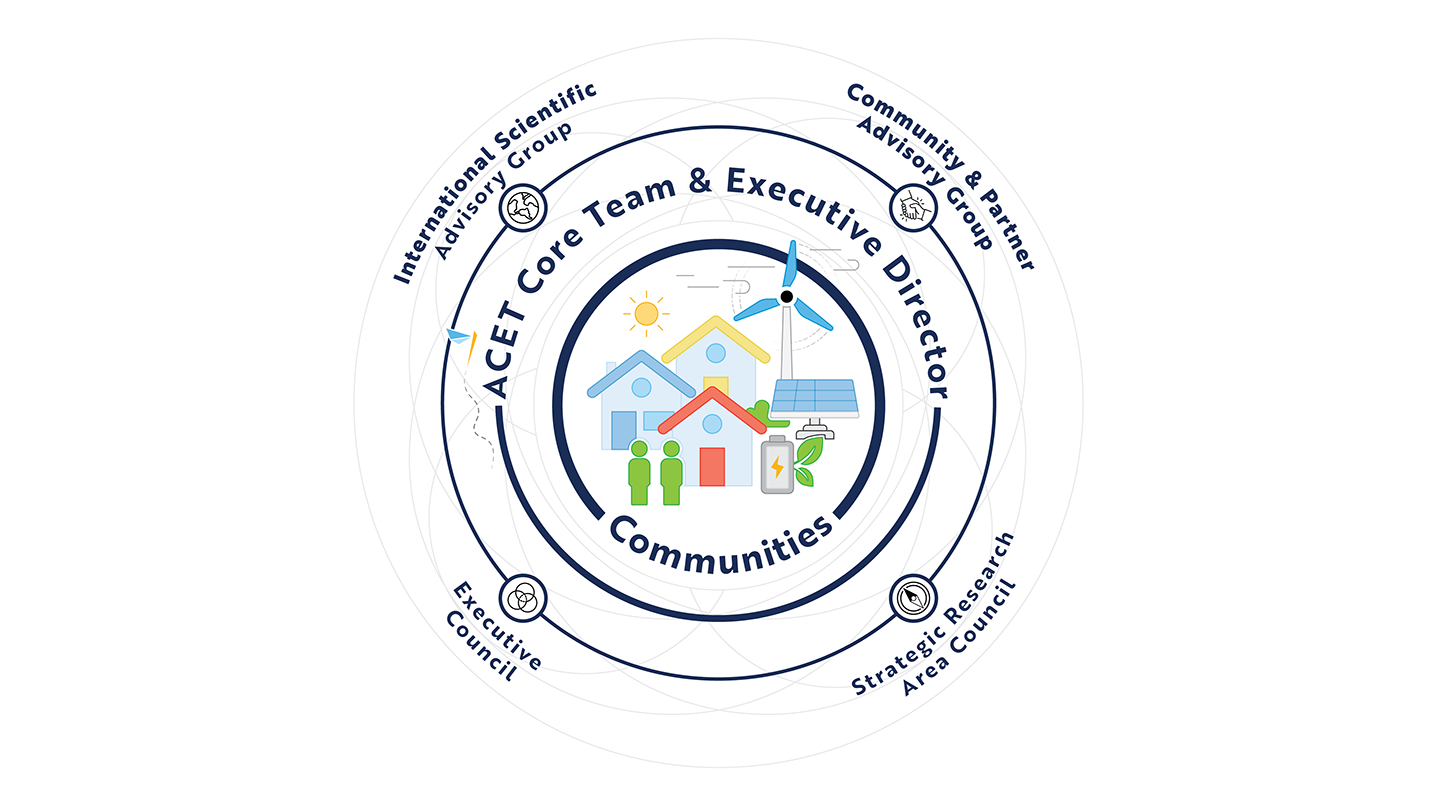
At ACET, governance reflects our core belief that energy transformation works best when it’s shaped by the communities it serves. Our community-engaged governance model ensures that research priorities, partnerships and strategic decisions are informed by the people and places at the centre of our work.
By bringing together communities, researchers and partners, this model supports co-created research that is grounded in real-world needs and guided by diverse knowledge systems. Through this approach, ACET ensures that community engagement, collaboration and impact remain central to how we plan, govern and deliver our work.
Communities
Communities are at the centre of ACET’s governance model. They include Indigenous Nations and small- to mid-sized remote, rural and urban communities with populations less than 500,000.
By placing communities at the centre of governance and research design, ACET ensures that transdisciplinary research is developed and implemented in true partnership. Community perspectives inform strategic priorities, guide project development and help identify innovative technological solutions that may not emerge through conventional approaches.
Our initiative is committed to implementing calls to action from the United Nations Declaration on the Rights of Indigenous Peoples (UNDRIP) and the Truth and Reconciliation Commission of Canada, to respecting Indigenous data sovereignty (including Ownership, Control, Access and Possession (OCAP) principles), and to honouring Indigenous ways of knowing and being. As a team, we are actively and continually learning how to put these commitments into practice.
Reflecting ACET’s commitments to IDEAA (Inclusion, Diversity, Equity, Accessibility, and Anti-Racism) and reconciliation with Indigenous Peoples, all our governance bodies strive for composition reflecting a wide range of experience and backgrounds, Indigenous membership, and foster respectful dialogue which acknowledges multiple ways of knowing and diverse perspectives.
Executive Council
The Executive Council provides high-level oversight and approvals for the planning, development and implementation of ACET.
Members:
- Lisa Kalynchuk, Vice-President Research & Innovation, UVic
- Lalita Kines, Vice-President Indigenous (Acting), UVic
- Curran Crawford, Executive Director, ACET
- Rachel Fernandez, Associate Vice-President, Research & Innovation, UBC
- Yves Monette, Director of the Office of Strategic Research Initiatives, UQTR
- Bronwyn Hancock, Associate Vice President Research, YU
- Jo Axe, Dean, Graduate Studies, RRU
- Peter Cowan, President and CEO, Innovate BC
Strategic Research Area Council
The Strategic Research Area (SRA) Council oversees and provides leadership for ACET’s interdisciplinary research portfolio and formally approves research projects.
Members:
- Curran Crawford, Faculty of Engineering & Computer Science, UVic
- Michael Ross, NSERC Industrial Research Chair in Northern Energy Innovation, YU
- Samaneh Shahgladi, Department of Chemistry, Biochemistry & Physics, UQTR
- Basma Majerbi, Peter B. Gustavson School of Business, UVic
- Thomas Homer Dixon, School of Environment & Sustainability, RRU
- Madeleine McPherson, Faculty of Engineering & Computer Science, UVic
- Tamara Krawchenko, Faculty of Social Sciences, UVic
- Bryson Robertson – Faculty of Engineering & Computer Science
Community and Partner Advisory Group
The Community and Partner Advisory Group (CPAG) provides guidance on ACET’s strategic priorities, partnerships and long-term sustainability from the perspective of communities and partner organizations.
Members:
- Chris Fleming, Executive Director, Ministry of Energy and Climate Solutions
- Meaghan Bennett, Director, Natural Resources Canada
- Yuho Okada, President, Barkley Project Group
- Lynne Couves, Director, Pembina Institute
- Patricia Lightburn, Director of Policy, CanREA
- Keiver Tremblay, Head of Operations, Elastic Energy
- Megan Lohmann, Chief Executive Officer, Community Energy Association
- Gerorge Benson, Senior Manager of Economic Development, ZEIC
- Janice Ashworth, Senior Consultant, Dunsky Energy + Climate Advisors
International Scientific Advisory Group
The International Scientific Advisory Group (ISAG) provides independent academic guidance to support ACET’s goal of advancing world-leading research in community energy systems.
Members:
- John Robinson, Professor, University of Toronto
- Emmanuel Ackom, Senior Fellow, University of North Alabama
- Julie MacArthur, Professor, Cascade Institute
- Ian Mauro, PICS Director/Professor, UVic
- Jenny Lieu, Professor, TU Delft
- Lisa Wijayani, PhD Student, UBC
- Rupp Carriveau, Professor, University of Windsor
- Meryem Duygun, Professor, Aviva Chair in Risk and Insurance, Nottingham University Business School
Governance Principles
Members of all ACET governing bodies sign and adhere to ACET’s Code of Conduct and agree to confidentiality and conflict-of-interest requirements. These principles ensure that ACET governance remains transparent, respectful and aligned with the collaborative values that underpin our work.
Learn more about our team.