
Upcoming Events
Jess Gibbard - Voice-Gender Modulation Workshop
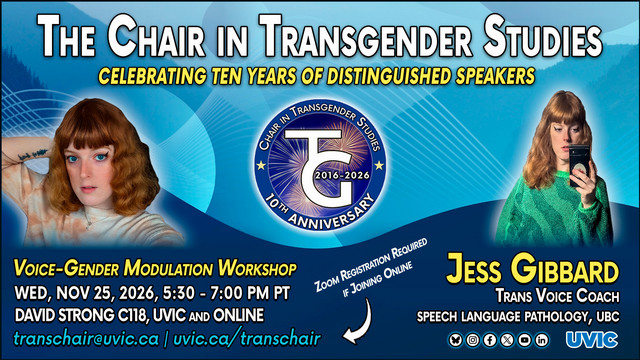
Jess Gibbard
VOICE-GENDER MODULATION WORKSHOP
Wednesday, November 25, 2026
5:30 PM - 7:00 PM PDT
David Strong C118, UVic & Online
Registration Requied if Joining Online
For many people, their voice is a core part of their identity, and for trans people this may be even more true. The process of learning to change one's voice throughout transition, often called voice training, can be daunting and overwhelming. But it doesn't have to be! Join us on November 25th for a group workshop on voice masculinization, feminization and androgynization hosted by Jess Gibbard of transvoicecoach.com. Whether you're a seasoned voice veteran or have yet to take your first step into training, this is an excellent opportunity to learn about or begin finding your voice.
Jess Gibbard has been actively teaching voice-gender modulation for the past five years and has helped many different clients embark on their voice journeys. She has also provided developmental assistance for speech pathologists who offer voice-gender related services. In addition, she is partnered with www.transacademy.org - a registered United States 501(c)(3) charity which aims to provide weekly, free group voice lessons to the public. Jess graduated from the University of Victoria in 2026 and she holds a BSc in Linguistics with Honours, Distinction, and a minor in Psychology. She is currently continuing her education in an MSc of Speech Language Pathology graduate program at the University of British Columbia.
Jonah Garde - Return Speaker Series
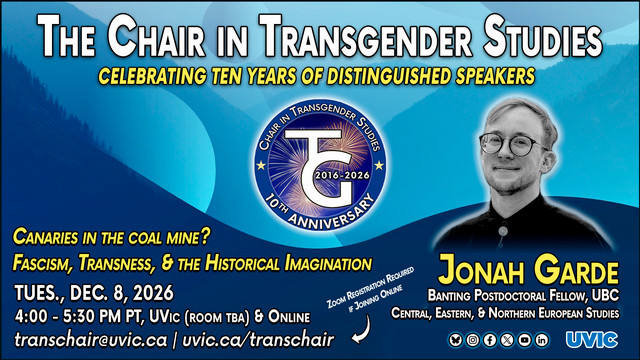
Jonah Garde
CANARIES IN THE COAL MINE?
FACISM, TRANSNESS, & THE HISTORICAL IMAGINATION
Tuesday, December 8, 2026
4:00 PM - 5:30 PM PT
UVic [ROOM TBD] & Online
Registration required if joining online:
“Transvestites are the canaries of the world,” proclaims a fictionalized Dr. Magnus Hirschfeld in Milo Todd’s recent novel The Lilac People (2025). In doing so, Todd’s Hirschfeld echoes a widespread political metaphor that casts trans people as “canaries in the coal mine.” In this perspective attacks against trans people are understood an early warning sign of broader authoritarian threats—a framing that has gained traction in contemporary media and activist discourses.
In this talk, I examine how the trope of trans people as “canaries in the coal mine” mobilizes an antifascist historical imaginary, one in which certain trans pasts are selectively recuperated and made legible as politically useful, while other histories—those that are less assimilable to liberal democratic narratives—are rendered unspeakable or erased. Through this analysis, I trace how the invocation of trans suffering as predictive or symbolic can both enable resistance and risk flattening the complexities of trans experiences in the past and in our current moment.
Jonah I. Garde is a Banting Postdoctoral Fellow at the Department of Central, Eastern, and Northern European Studies at the University of British Columbia (UBC). Previously, they have completed their PhD in Gender Studies from the University of Bern for which they received the Barbara Lischetti Award for outstanding work in the field of Gender Studies.
In 2025, Garde published Trans* Geschichten der Moderne: »Geschlechtsumwandlung« im 20. Jahrhundert und ihre kolonialen Geister (transcript, 2025) which explores how trans* histories are entangled with modernity and colonialism in early-20th-century Austria. The book offers an in-depth analysis of how ‘sex change,’ both as an idea and a medical practice, was reshaped in the early 20th century by modern medicine and biology, mass popular culture, as well as colonial discourses.