
 Donate
  Archives
  Mailing list



Chair in Transgender Studies
Territory acknowledgement
We acknowledge and respect the Lək̓ʷəŋən (Songhees and Xʷsepsəm/Esquimalt) Peoples on whose territory the university stands, and the Lək̓ʷəŋən and W̱SÁNEĆ Peoples whose historical relationships with the land continue to this day.
Our work: fostering research & scholarship in Trans Studies
- Encouraging both existing and new scholars to pursue careers in Transgender Studies and building local, national, and international linkages with others working in Transgender Studies
- Hosting visiting academic and community scholars
- Proactive community outreach and knowledge mobilization
- Teaching and mentoring related to the area of Transgender Studies
- Fundraising in support of the Chair in Transgender Studies and the Transgender Archives
Research
Academic and community-based scholars visit with us throughout the year. Many of them have come to make use of the Transgender Archives.
Moving Trans History Forward

Community activists, researchers, educators, artists, service providers, and allies come together to create a better future.
Public events
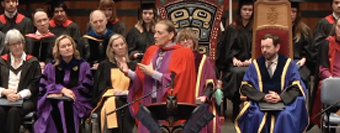
The Chair in Transgender Studies holds a variety of public events, including guest speakers, social and arts events, and honorary degrees!
Video message

A donation by the Tawani Foundation, founded and led by Lieutenant Colonel Jennifer N. Pritzker, US Army (Retired), supports the inaugural chair in UVic’s Faculty of Social Sciences for five years.
Latest YouTube Videos

TRANS[FORMATION]: Digitizing Historical Trans+ Audiovisual Materials
DONATE 🇨🇦 https://extrweb.uvic.ca/donate-online/transchair 🇺🇸 https://extrweb.uvic.ca/donation-forms/united-states Vault - UVic Libraries: https://vault.library.uvic.ca/ Chair in Transgender Studies: https://www.uvic.ca/research/transchair/index.php Transgender Archives: https://www.uvic.ca/transgenderarchives/index.php Moving Trans History Forward: https://www.uvic.ca/mthf TRANS[FORMATION] Digitizing Historical Trans+ Audiovisual Materials: A Community Conversation about Accessibility and Risk Tuesday, June 23, 2026 12:00 PM - 1:30 PM PDT (ONLINE ONLY) University of Victoria (UVic) Libraries is home to the world’s largest Transgender Archives, a joint project with the Chair in Transgender Studies. In 2024, UVic Libraries received a Digitizing Hidden Special Collections & Archives: Amplifying Unheard Voices grant from the Council on Library and Information Resources (CLIR) to digitize, preserve, describe, and make accessible at-risk audio-visual items documenting histories of Trans+ activism throughout the 1970s-2000s. The two-year grant runs through to the beginning of 2027. Cultural heritage organizations must navigate the ethically charged waters of protecting privacy while at the same time aspiring to openness and accessibility. These waters become increasingly challenging to navigate when today’s sociopolitical climate and technological advances are taken into serious consideration. Grappling with these ethical and practical tensions is at the core of the project, Trans(formation): Digitizing the Rikki Swin Institute Trans+ Activism and Outreach Media Collection. These tensions are of particular importance when creating digital collections of historical materials depicting Trans+ communities, whose survival throughout much of history has depended on the ability to keep their gender diversity hidden. This conversation-based online workshop offers a structured forum for Trans+ community members and allies who have relevant professional expertise. The session will review the progress of the project and invite participants to advise on how to best balance offering appropriate accessibility to historical Trans+ audiovisual materials against the risks associated with making the materials publicly available. Interested in learning more? Contact mikerad@uvic.ca. Michael Radmacher (MA, MLIS) is the Transgender Archives Metadata & Outreach Librarian at University of Victoria (UVic) Libraries. He has supported UVic’s Transgender Archives since 2014, has worked with UVic’s Chair in Transgender Studies from 2016 to 2025, and was the lead organizer of five international Moving Trans History Forward conferences. He is a member of the Homosaurus collective who currently serves on the Organizing Board. Dr. Aaron H Devor, PhD, FSSSS, FSTLHE, is the Chair in Transgender Studies at the University of Victoria (UVic) and has been studying and teaching about transgender topics since the mid-1980s. He is the Founder and Subject Matter Expert of the world’s largest Transgender Archives, Founder and Host of the Moving Trans History Forward conferences, a former Dean of Graduate Studies, and a professor of Sociology at UVic.
Avery Dame-Griff: Our "tired old flame queens”
DONATE 🇨🇦 https://extrweb.uvic.ca/donate-online/transchair 🇺🇸 https://extrweb.uvic.ca/donation-forms/united-states Chair in Transgender Studies: https://www.uvic.ca/research/transchair/index.php Transgender Archives: https://www.uvic.ca/transgenderarchives/index.php Moving Trans History Forward: https://www.uvic.ca/mthf AVERY DAME-GRIFF Our “tired old flame queens:” Studying and Archiving Trans Histories of the Digital Age Tuesday, June 9, 2026 5:00 PM - 6:30 PM PDT Like all social movements, internal debate has been a hallmark of formal transgender organizing since its beginning. Who “belongs” within communities? What should we call ourselves? What are the most effective political tactics for reaching the public and policy makers? With the rise of the internet, though, discussions previously confined to letter columns and in-person committee meetings moved online. There, posts meant for like-minded audiences not only spread far beyond their immediate context but also have a much longer and more visible afterlife with the rise of search engines. Arguments made in the heat of the moment—especially when made with an old name or company email attached—can come back to haunt posters long after. In this talk, I'll explore how historians and archivists can adapt to these changes through the case study of an early 2000s multi-year flame war between two transgender activists and well-known posters on Usenet, an early decentralized network online. What began in the transgender-specific corners of Usenet soon sprawled far beyond to involve mentalists, magicians, and eventually the American Tea Party movement. As this case shows, contextualizing born-digital communication at the local, network, and community level is key to both historical research and archival preservation, particularly when determining access restrictions—including if such objects should be preserved at all. Avery Dame-Griff is a Lecturer in Women, Gender, and Sexuality Studies at Gonzaga University and author of The Two Revolutions: A History of the Transgender Internet (NYU Press, 2023). He founded and serves as primary curator of the Queer Digital History Project (queerdigital.com), an independent community history project cataloging and archiving pre-2010 LGBTQ spaces online.See more videos from the Master Playlist playlist on YouTube.