
2026 UVic Law graduate research students
September 28, 2026

A new cohort of graduate researchers have arrived at UVic Law. This year’s 10 PhD and LLM students are contributing to conversations on law, justice and social change through research on Indigenous legal traditions, governance and sovereignty, identity and belonging, tax and fiscal policy, transgender rights, constitutional authority, post-secondary policy, traditional medicinal knowledge, criminal justice reform and intersections of grievance and victimhood in legal and social discourse. Learn more about the research of the 2026 incoming grad students below.
David Akinwunmi

LLM in Law and Society
Thesis: Beyond coercive taxation: Canadian Indigenous fiscal experiments and their relevance for Nigeria’s informal economy.
Supervisor: Dr. Bradley Bryan
The background of this study lies in the recent intensification of tax legislation in Nigeria. In ways never experienced before, the state is formalizing fiscal structures and introducing stringent administrative mechanisms to secure more comprehensive sources of public revenue. These reforms, however, have been met with considerable resistance, particularly within the informal economy, where most taxpayers have limited formal education and tend to value long-standing customary practices.
Against this backdrop, the research aims to draw lessons from Canada’s efforts to incorporate Indigenous governance, norms, values, and practices into its tax and fiscal frameworks. By examining both the shortcomings and achievements of these Canadian initiatives, the study seeks to identify principles that could be adapted to the Nigerian context. The broader objective is to explore how integrating indigenous elements into Nigeria’s tax system could foster a more equitable relationship between the state and its citizens, thereby enhancing the social legitimacy and acceptance of taxation.
Kiana Cardinal-Arcand

LLM in Law and Society
Thesis: Nêhiyaw (Cree) cosmology, star teachings, and ceremony as foundations of Cree law and governance.
Supervisor: Dr. Darcy Lindberg
Research summary: My thesis research explores Nêhiyaw (Cree) cosmology, star teachings, and ceremony as foundations of Cree law and governance. I hope to examine how knowledge carried through the stars, stories, language, and ceremonial practices expresses legal principles relating to relational accountability, ecological balance, responsibility, and collective well-being. I am particularly interested in how reawakening and engaging with these teachings can strengthen contemporary Cree governance and legal sovereignty while supporting the intergenerational transmission and continuity of Cree legal orders. Grounded in a Cree worldview and Indigenous legal methodologies, this project approaches these teachings as sources of Cree law and considers what they can offer to Cree governance and self-determination today.
Christopher Derrickson

PhD in Law and Society
Thesis: The modern sources of indigenous identities: an exploration and synthesis of legal, societal, philosophical and traditional concepts of self, community and land.
Supervisor: Dr. John Borrows
Research summary: The research topic I intend to pursue is a response to, “Way̓ swit askʷist?”, a common greeting in nsyilxcen, the language spoken by the syilx (Okanagan). In English it means, “Hello, what is your name?” However, a transliteration reveals the depth of what is being asked: “Greetings! Who are you from, who and what land do you belong to?” It is a formal acknowledgement of existence and a question about origins, family, community, and tm̓ xʷúlaʔxʷ (place or land). It is an invitation to imagine what is, or in this case who or what relationships are, intrinsic to your identity.
For modern Indigenous peoples residing within a colonial nation-state, this question is complicated by history and layers of colonial legal instruments and institutions. Indigenous peoples have been forced to take on a colonial identity informed by social and legal definitions while finding ways to develop and express a more nuanced and authentic existence that is grounded in their respective culture, language, stories, and laws. Displacement and dispossession fundamentally altered these historic sources of identity, while mobility and climate change are threatening a new round and kind of displacement and dispossession. Regardless of the impetus driving change, identities are fundamentally relational and Indigenous agency must remain the author.
Another syilx greeting asks, “What brings you here” or “why are you here?” This research is why I am here; I am seeking to understand the various historic and modern sources of Indigenous identity and attempt to synthesize these with current theories in developmental psychology and philosophy. This research will contribute to the current debates and conversations on the nature of Indigeneity within Canada, and in turn provide insight as to how law and policy can be shaped to facilitate the nuances of this evolving identity. It will also provide practical pathways for others to find their way through to discovering who they are from, and what land they belong to.
Olívia Fonseca Maraston

LLM in Law and Society
Thesis: How activism shapes transgender rights: a comparative analysis of Brazil, Canada and the UK
Supervisor: Prof. Gillian Calder
Research summary: My research intends to examine how transgender activism influences the recognition and protection of trans rights in different legal and political contexts. Through a comparative analysis of Brazil, Canada and the United Kingdom, I aim to understand how activist movements shape laws, public policies, and public debates related to gender identity. By contrasting Brazil's challenges with the experiences of the U.K. and Canada, the research seeks to identify structural gaps and explore pathways through which activism can promote more inclusive and effective protections.
Rather than examining laws in isolation, I want to understand how rights are claimed, negotiated, and contested through collective action.
Beyond the textual content, I am interested in examining their material forms, including pocket-sized pamphlets, newsletters, and self-published magazines. The format, circulation practices, and concealability of these publications often functioned as strategies of resistance in hostile social and legal environments.
Kelly Mitchell

PhD in Law and Society
Thesis: Judicial function and Māori legal theory: reimagining constitutional authority in a plural legal order.
Supervisor: Dr. Estair Van Wagner
Research summary: My planned research builds upon the groundwork laid in my Master’s thesis, which consolidated the case for a Māori legal theory. That thesis primarily found that Māori Legal Theory exists already because Māori legal action exists but posited a primary framework for perceiving it using the three spheres of influence described in Matike Mai; the Rangatiratanga (Māori authority) sphere, the Kāwanatanga (Crown governance) sphere, and the Relational/Interlegal sphere. The PhD will develop this by further clarifying Māori legal theory, and as a case study, considering how the theory can inform understanding the constitutional role of the judiciary.
The research question guiding this project is: How can Māori legal theory inform and reshape our understanding of judicial function within Aotearoa New Zealand’s constitutional framework? The study will examine how Māori legal theory supports a constitutional vision that repositions the judiciary from a role of unitary interpretive authority to one of relational engagement across legal orders. Te Tiriti o Waitangi (the Treaty of Waitangi) recognised and formally affirmed tino rangatiratanga and kāwanatanga as expressions of Māori and Crown authority, but left unresolved the constitutional question of how those spheres should interact. In the absence of an agreed framework governing that relationship, tikanga Māori has routinely emerged as a primary point of engagement. Beyond the direct Treaty partnership, it is now seeing increased influence within contemporary common-law decision making, challenging inherited assumptions about the judiciary’s role within Aotearoa New Zealand's evolving constitutional order.
Emma Naismith

LLM in Law and Society
Thesis: Beyond crisis response: institutional approaches to chronic high-risk student behaviour in Canadian universities.
Co-supervisors: Dr. Janna Promislow
Research summary: Canadian post-secondary institutions often encounter student behaviour that creates ongoing risk of harm to self or others without meeting legal or clinical thresholds for emergency intervention. Existing conduct, safety, and behavioural intervention frameworks tend to focus on individual incidents or prescribed outcomes, offering less guidance for circumstances requiring sustained and complex management, accommodation, and decision-making.
This research will explore how post-secondary institutions might better identify and respond when continued accommodation of behaviours carrying risk of harm begins to place unsustainable pressures on both the humans involved and practical resources. An emerging interest is how cumulative distress, trauma, disruption, or safety impacts on administrators might impact the quality of decisions and inform considerations of undue hardship.
Given an institution’s responsibility for student wellbeing, these frameworks also raise ethical questions about the decisions they support, and the authority institutions hold in determining outcomes under policy. This inquiry will consider how a student’s health and social circumstances, and potential vulnerabilities, can be meaningfully considered within these processes.
Drawing largely on qualitative empirical research and comparative policy and legal analysis, I hope to provide insights that can inform policy development and contribute towards more nuanced, trauma-informed, and sustainable approaches to managing chronic high-risk student behaviour in Canadian colleges and universities.
Geneviève Richard

PhD in Law and Society
Thesis: The Voices of the Atikamekw Nehirowi Iskwewok in Quebec on harm and injury: Revitalizing Indigenous Legal Traditions from a Feminist Perspective.
Supervisor: Dr. Val Napoleon
Research summary: My doctoral project, rooted in action research and co-construction with the Atikamekw Nehirowisiw Nation in Quebec, will explore the ways in which Atikamekw women can revitalize their legal traditions in criminal matters in order to address the shortcomings of a system that is failing them.
My central research question is as follows: How do Atikamekw Nehirowi Iskwewok (“woman” in Atikamekw Nehiromowin language) and elders articulate the law of harm and injury, and how can their valuable expertise and historic legal knowledge guide the re-establishment of that legal order for the benefit of the Nation?
The context of my research is a crisis that has been widely documented in this country for about sixty years: the massive and chronic overrepresentation of Indigenous people in the prison system, particularly Indigenous women. This “crushing failure” of the Canadian criminal justice system has been highlighted by numerous commissions of inquiry and even by the Supreme Court of Canada. One widely advocated solution is to revitalize Indigenous legal orders, while ensuring that the voices of Indigenous women—who are all too often marginalized—are heard in this process.
By contributing to the articulation of a legal order that reflects Atikamekw principles and needs, this research aims to restore dignity to individuals and communities long subjected to a justice system that has failed them.
With this research, I hope to build on the progress made in Indigenous Laws in British Columbia and bring it to Quebec, promoting specifically Atikamekw legal orders.
Lauren Sapic

PhD in Law and Society
Thesis: Grievance jurisprudence: law, emotion, and the politics of “victimhood.”
Supervisor: Prof. Gillian Calder
Research summary: My doctoral research develops “grievance jurisprudence” as a socio-legal and feminist framework for examining how the emotional discomfort, status anxiety, or perceived loss of historically dominant groups can be translated into legally cognizable harm. With tentative case studies located in Canada, Ireland, Sweden, and the United States, my PhD research will not only explore moments where instances of dominant-group grievance were juridified, but also what may follow when any political strength a dominant group may have had, dissipates. I’m also particularly interested in when any legal decision after the wane of a dominant group is challenged, appealed, amended, or repealed. One historical case study along these lines that will be explored is the constitutionalization of abortion regulation in the Constitution of Ireland, following its 1983 “Eighth Amendment,” to its 2018 repeal.
Building on my earlier LLM research at UVic on credibility, visibility, and mediatized justice in the Hockey Canada “E.M.” sexual-assault case, a further focus will be how groups experiencing status anxiety increasingly adopt the language of victimhood, discrimination, and “equal treatment” to frame any perceived losses of power in legal claims. I’m particularly interested in whose grievances become legible as legal harms, how institutions respond to competing narratives of injury, and what these responses reveal about changing distributions of social and political power.
.
Akriti Singh

LLM in Law and Society
Thesis: Traditional medicinal knowledge governance after the Wipo Gratk treaty: a comparative socio-legal study of India and Canada.
Supervisor: Prof. Robert Howell
Research summary: My thesis examines the consequential potency of the 2024 WIPO GRANT Treaty and how the Basic Principles of the Nagoya Protocol can strengthen the protection and governance of traditional medicinal knowledge, with an initial comparative focus on India and Canada. I am particularly interested in exploring the dilemma of ownership of cultural property, given the mobile nature of communities, and whether mandatory disclosure and prior-art protection are sufficient to prevent misappropriation, or whether meaningful Indigenous community participation, consent, data sovereignty, and benefit-sharing mechanisms are also necessary in the context of the nomadic nature of Canadian Indigenous communities and concentrated indigenous communities of India.
The study will use doctrinal and qualitative socio-legal research methods, including interviews with knowledge holders, legal practitioners, and relevant institutions, and the governance landscape around the traditional knowledge library in India.
To gain a normative perspective, I intend to examine the cross-jurisdictional legal framework on patents, the constitutional framework and Indigenous legal orders. This way, the study aims to develop and recommend a practical hybrid governance model that balances the effectiveness of examining normative frameworks with Indigenous legal and pragmatic sovereignty over traditional medicinal knowledge.
Barbara Wilson
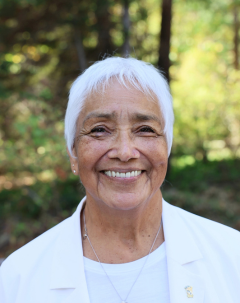
PhD in Law and Society
Thesis: Manifesting good trouble: reinvigorating old laws. Mama said, “someone has to know.”
Supervisor: Dr. John Borrows
Research summary:
Introduction: The Kuuniisii (ancestors) of the St’aaw.waas XaaydaGaay, the Cumshewa Eagle Clan’s, ancient laws show what could guide the care for all aspects of our lives and homeland, as they did for thousands of years. Our history, and my life lived will be central as examples of what our families experienced from colonial laws. Descendants will be encouraged to learn possible positive options to the colonial laws founded on the discredited Doctrine of Discovery.
Chapter One: "Using my clan’s ancient laws to protect precious food, threatened by Federal Laws and Agencies." Use of lived examples of Ad k’yaanang t’laang (Ask First) and CoastalVoices: a case study. Show examples of ancient laws being followed and hypotheses proven for the past thirteen years. Experiences using ancient protocols and upholding responsibilities of the Hemas, Hawiid and ‘Laana AwGalang for the people, lands, waters, food security, customs, laws and remember everything is one. Include other Advisory activities.
Chapter Two: "How Transparency and Living Your Words and Tll’yahda Could be Used to Address the Problems of Pollutions such as Plastics and Colonial effects." Explain what it means to King.Guu (promise or Live Your Words), Hlk’aajuu (Transparency), and other phrases or words in a glossary and the difference between our laws and Western laws. Making actions and words legal will be part of this.
Chapter Three: "Addressing Intergenerational and Lived Trauma in a partnership with Mental Health." The Haida Heritage School Curriculum and activities are open to the Haida. Courses will be taught by Mentors (knowledge holders). In our school we offer education and healing for people coming home from treatment centers, as well as Haida who just want to learn. The aim is to uphold and pass on knowledge, lifeways, laws, impact our generations with GOOD TROUBLE.
Conclusion: How these actions can be amalgamated and upheld.
Note: Xaaydaga kil (Haida Words and Orthography) will be used throughout the dissertation with numbered footnotes with English explanations when necessary.