
Dr. Darcy Lindberg receives REACH Indigenous Scholar Award
May 01, 2026
By David Murphy
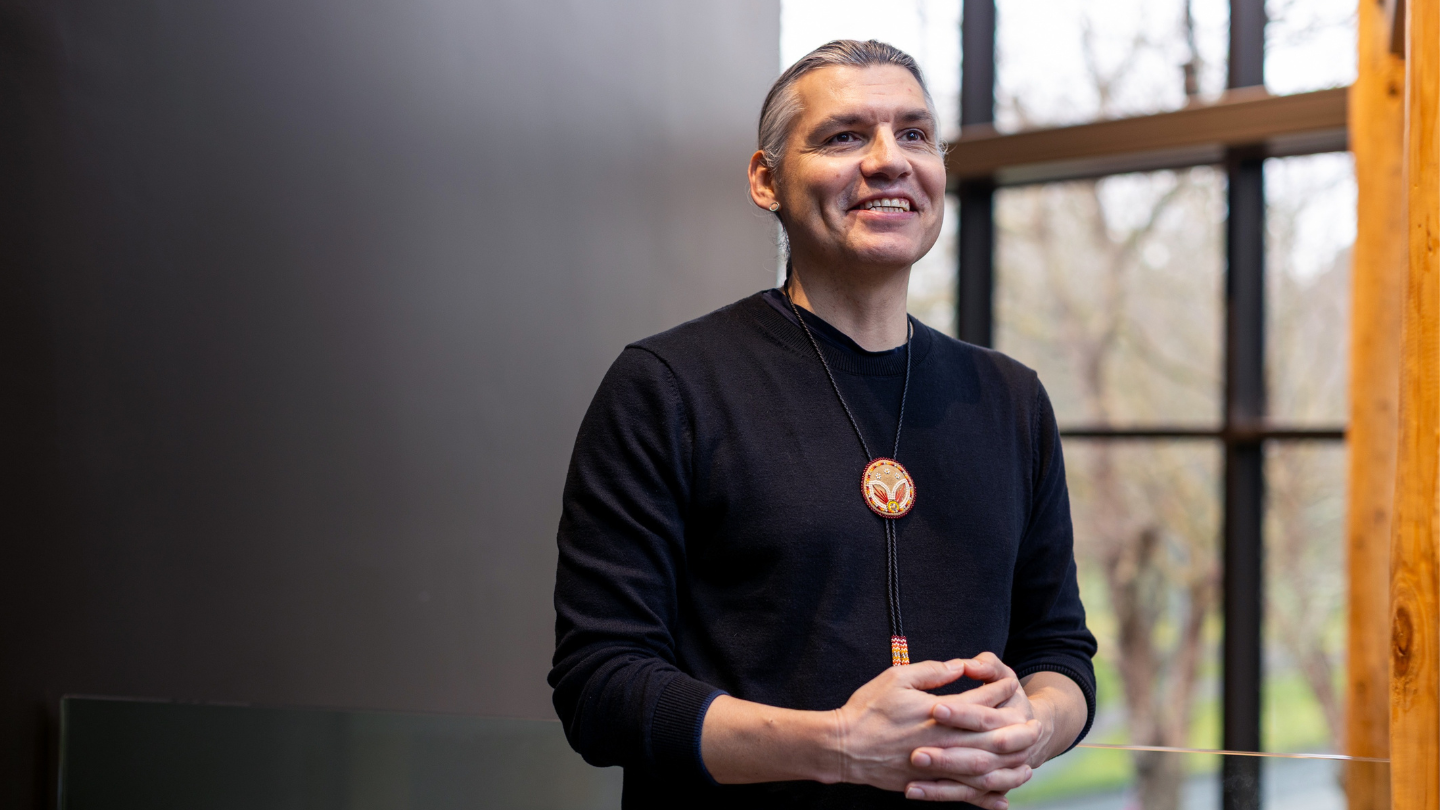
Dr. Darcy Lindberg is transforming the landscape of Indigenous law research.
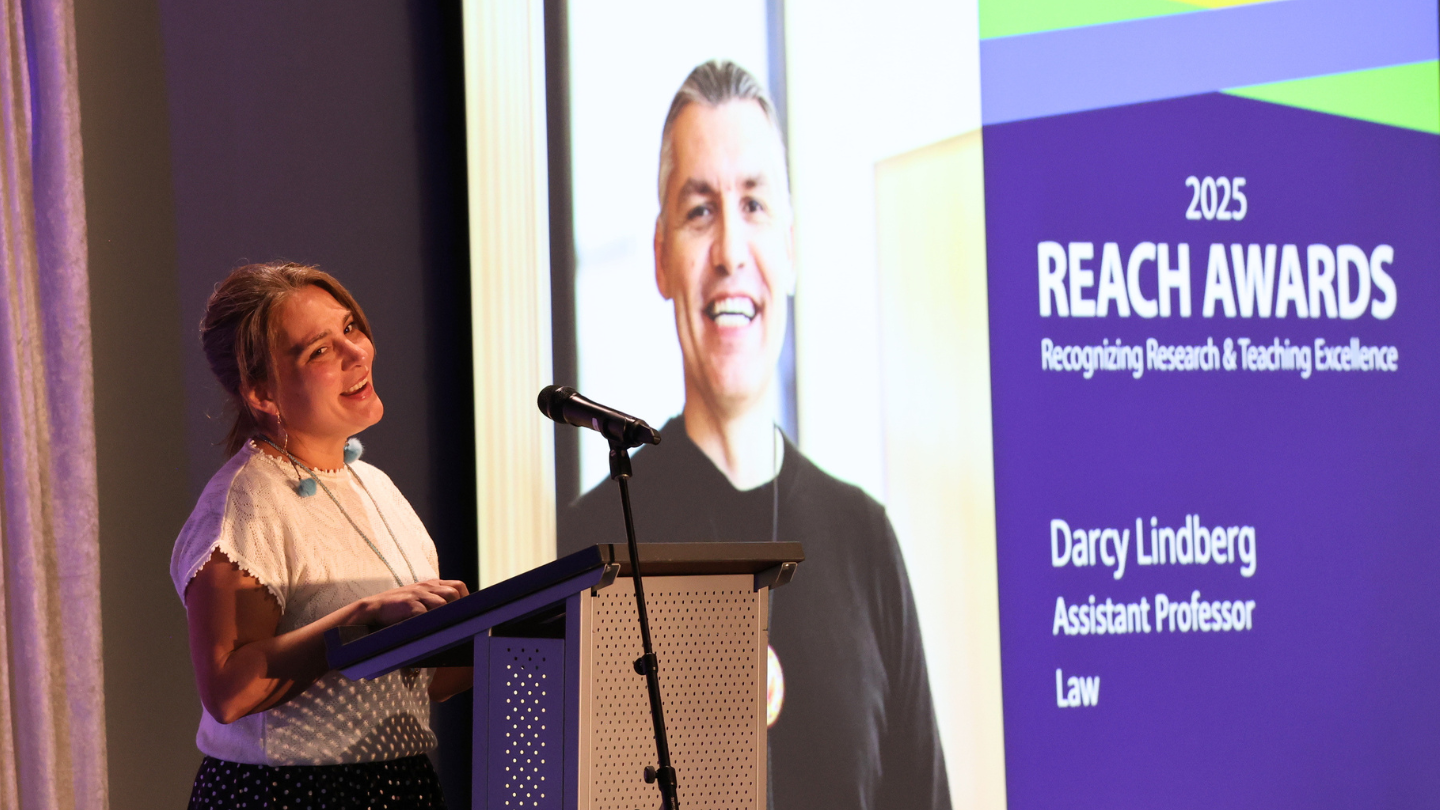
That impact is why the UVic Law assistant professor is being recognized as the 2025 recipient of the ʔəy̓ nəwəl ʔist | ÍY,NEUELIST | Moving forward together for the good of all | Indigenous Scholar Award for Excellence in Research.
“My research is an attempt to recover the many ways that knowledge has always revealed itself to us, and the methods we have always used to make those revelations seen,” says Dr. Lindberg. “I am just lucky enough to be here at this point where there is a swell of momentum in this work.”
This marks the third year UVic is celebrating Indigenous researchers with the REACH Indigenous Scholar Award, and the first time it has been awarded to a UVic Law faculty member.
Dr. Lindberg’s scholarship goes beyond theory fixed in time or shelved in journals and books. His work acts as an agent for change in the resurgence and revitalization of nêhiyaw/Cree and Indigenous law – and he shares it in ways that have immediate and direct impact.
Practically, that looks like creating toolkits, advancing Indigenous trade relations or presenting his expert opinion to judges, senators and Indigenous organizations. Recently, his expert opinion on nêhiyaw/Cree legal principles was cited extensively by the Court of King’s Bench of Alberta in its decision on the constitutionality of a proposed Alberta independence referendum.
Or take, for example, his latest paper: Nêhiyaw Pimatisiwin and Regenerative Constitutionalism (2025). It braids three areas of nêhiyaw pimatisiwin (the Cree way of life) – land-based legal pedagogy, the Cree language and nêhiyaw narrative traditions – to equip future generations with legal agency in times of environmental crisis.
“Dr. Lindberg’s scholarship is helping shape how courts, governments and Indigenous nations understand the role of Indigenous law in governance, environmental stewardship and reconciliation,” says Dr. Sarah Morales, UVic Law’s Associate Dean Indigenous.
“His work both advances and deepens understandings of Indigenous legal orders, and contributes to the decolonization of law, policy and legal education at UVic and across the country,” says Morales.
Dr. Lindberg is mixed-rooted, non-status nêhiyaw (Plains Cree), with his family coming from maskwâcîs in Alberta and the Battleford-area in Saskatchewan. He completed his JD, LLM and PhD at UVic Law, and since his 2021 appointment as assistant professor, he’s worked with both the Indigenous Law Research Unit and the Environmental Law Centre.
You can often find him in the new Indigenous Law wing, teaching JD/JID classes in the Sky Classroom or on the Outdoor Learning Deck. These spaces integrate the law school with the natural world, showing how our more-than-human relations shape our understanding of legal obligations.
It’s a lesson that embodies Dr. Lindberg’s approach to research.
“An important part of my research is often focused on the interaction of Indigenous laws with other academic fields and areas of society,” says Dr. Lindberg. Those fields include Canada’s constitutional framework, environmental regulation, gender, language and more.
In this way, Dr. Lindberg advances the field of law by bringing Indigenous legal orders into meaningful conversation with state law and other disciplines, says UVic Law Dean Freya Kodar.
“Dr. Lindberg’s work is necessarily interdisciplinary and multi-disciplinary,” says Kodar. “He is someone at the forefront of creating a new academic discipline of legal studies that is transsystemic in nature – working across systems of law including Canadian and Indigenous law.”
Most importantly, however, is nêhiyaw law and how it shapes Dr. Lindberg’s research approach.
“I am guided by two principles rooted within nêhiyaw pimatisiwin,” says Dr. Lindberg.
“The first is how Elders say they “don’t know much” before sharing their experience and knowledge – a way to ground themselves as learners,” he says.
“The second is the acknowledgement that no matter the position, we sit just as close to the central fire that binds us. This is why we often favour working in circles, to remember that one person does not sit closer to the centre than another, each just as significant in the journey as others.”