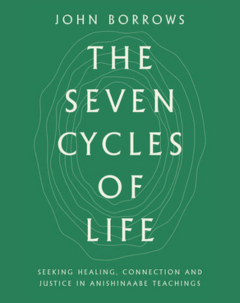
Dr. John Borrows navigates time in new book: The Seven Cycles of Life
July 07, 2026

By David Murphy
About the author and book
UVic Law professor Dr. John Borrows (on leave) has written many award-winning books, but none as personal and introspective as The Seven Cycles of Life: Seeking Healing, Connection and Justice in Anishinaabe Teachings.
Widely regarded as one of the leading scholars of Indigenous law, Dr. Borrows has helped reshape Canada’s legal landscape. His books are taught in law schools around the world.
But Dr. Borrows’ first commercial book stands apart. Released in May 2026, The Seven Cycles of Life is a memoir of sorts, featuring a collection of vignettes from his past. It isn’t a textbook on constitutionalism or treaty rights. Instead, it challenges readers to reflect critically on the world around them.
Written over the course of 15 years, Dr. Borrows takes readers into his inner world. Revealed one short story at a time, he shares origin stories from different stages of life that helped shape his expert Indigenous legal theories, weaving them with Anishinaabe knowledge.
A typical vignette starts with an observation about the world around him, drawing lessons from the sky, trees, relationships and the land. Dr. Borrows applies Anishinaabe teachings to topics ranging from law school and modern technology to coexistence and death. His stories feature encounters with bears, hawks, bees and deer. In the audiobook, his calm and measured narration takes listeners on a mindfulness journey you might expect from a meditation app.
Ultimately, Dr. Borrows says he doesn’t want people to agree with the book as much as he wants it to provoke reflection. He hopes readers will think about how they are living in relation to the law, spirituality, education, relationships and the more-than-human world.
Q&A
What is the book about?
The book is a meditation on time. What do we do when we keep experiencing opportunities and challenges from different perspectives as we move through life? Being a child is different than being a teenager, adult, or Elder. Understanding time and our relationship to time as we move through different cycles is to see possibilities that time gifts us, and the challenges that accompany it too.
What is the Anishinaabe view of time?
Anishinaabe language has time as animate. Time is a living being. In that way, you're in a relationship with this animate being. So, you can treat that being well, or you can treat that being poorly. If you treat time well, you'll find some reciprocity coming back to you. But if you're pressing time, ignoring time, not giving time its due, you'll find yourself in a very poor relationship with that being.
How is this different from your previous books?
Usually I write linear pieces focused on courts, legislatures, and policy. This is not that work explicitly. I've tried to de-center those things without leaving them behind, to give another point of entry into the same debates and ideas so you can see them from another angle.
The book doesn’t take a linear narrative. Why is that?
The book is a memoir, but it’s a memoir on time. The book is quite insistent that life isn't just chronological. It's experiential. Like a kaleidoscope, all of these cycles mix together. I'm in all of the cycles right now. We can bring out different dimensions of them at different points in the day and throughout our lives. I mix and mingle experiences along the way because that's the way life comes at us. Life can look linear if we measure it by a clock, but there's a lot of a-synchronicity. You're experiencing time differently than I'm experiencing time right now. We have to give space for that.
How would you categorize this book? Is this a law book, autobiography, self-help?
I think it's partially philosophy, law, religion and spirituality. It's partially nature literature, reflecting on the world around us. It's got some different categories that it slides into along the way.
Who is the audience for this book?
When I first started, I was writing it to my daughters. Then my youngest daughter started having children and I realized maybe I'm writing intergenerationally. Eventually I stepped back even further and focused it on life and law that resonates with other people.
What impact do you want this book to have?
I would like this book to land on people's side tables as they wake up in the morning, as they go to bed in the evening. Each chapter contains small vignettes you can read or listen to in three or five minutes. The point is to slow down, consider, ponder and think about where you are in time and what you're doing with it.
What is the relevance of stories in the book?
Stories show law beyond the state. The Old Barn features a story of when I discovered a injured red-tailed hawk as a child. Government resources said they couldn't help. But my mother turned to Elders, stories, teachings and learning. She drew on responsibilities and relationships to care for the hawk. As a young person, I watched that work and learned from it. We healed the hawk and I watched it fly away. Anishinaabe Law teaches us that we have responsibilities for that red-tailed hawk. Often, we find ourselves in situations where it seems like there's no resources to help us. But that doesn't mean we're hooped. We reach out to knowledge keepers, we reach out to family, we learn more about the situation before us and we bring law, standards, principles, authority, guideposts, measures, and processes to help regulate our affairs and resolve our disputes.
What role does law play in the book?
The first chapter is called The Good Life, which can be regarded as the treaty life. We often think of treaties as contractual arrangements, with the Crown or First Nations, where there's a keeping of score, a quid pro quo, a transactional way of being in the world. But for many Indigenous peoples the first treaties are with the more-than-human world—the plants, animals, rivers and insects. That’s not a contractual relationship. That sense of the relationship takes precedent. That relationship is grounded in appreciation, gratitude, respect, learning and care. It's understanding that we're here because they're here. And that's a very different view from the way the courts talk about treaties, the way we talk about them in policy circles. Law is a coordination of activities. If you take care of the bear, you're also taking care of your community, the fish and the more-than-human world around you.
How has UVic Law influenced your thinking and this book?
When I first came to UVic Law in 2001, I was thrilled to see that law was a practice—not just something that only courts or legislatures do. They're not the only ones that do law. This lesson, formed through UVic, has meant as a law professor, my responsibility is helping students help others practice law when they become lawyers. They provide information and opportunity.
I see law as a verb. It's something you conjugate. Often law is thought of as a noun—a contract, a tort, criminal law. It's much more than that. Everyone should be law-ing in different ways. The role of the legal profession is to empower the agency of the rest of society to get involved in law-ing
UVic sees law in its broader context like this. When I came back to UVic in 2013, that’s when this book began. This book has been a companion to my time at UVic as a Canada Research Chair and as a co-founder of Dr. Val Napoleon in the development of the JD/JID program. I wanted to bring out the social, political, family and relational dimensions of law alongside the more formal legal work I do.
Book information
Dr. John Borrows is a Professor of Law at the University of Victoria (on leave) and Professor and Loveland Chair in Indigenous Law at the University of Toronto. He is a member of the Chippewas of the Nawash First Nation. After his book tour, Dr. Borrows begins a Guggenheim Fellowship, examining natural resource disputes across Canada including LNG in northern BC, the oil sands in Alberta, the Ring of Fire in Ontario and fracking in Nova Scotia.