
Putting patients first
Guided by people who have survived complex relational trauma, Colette Smart and her University of Victoria (UVic) research team have created a training resource for health clinicians on trauma-informed care. The resource will support Island Health. Now Colette and her partners are rolling it out to the medical community in Victoria, BC, and beyond.
A career in care
From the beginning of her health-care career, Colette was drawn to studying the relationship between the brain, behaviour and emotions, with a particular interest in working with people who had serious illness.
She trained as a neuropsychologist in Chicago, New York and New Jersey, connecting with patients in clinical settings as they rehabilitated from various types of brain injuries and neurological illnesses. Her patients struggled with a variety of issues, like memory disorders and changes to their thinking and emotion regulation. Through assessment and rehabilitation, Colette focused on helping patients and their families figure out how to live well despite their suffering.
Moving to the South Island
Colette moved to Vancouver Island in 2010 for an assistant professor position at UVic, inspired to teach the next generation of psychologists and tackle big research questions in her field. After establishing herself in Victoria, she re-opened a private clinical practice to serve adults with chronic and catastrophic illness. But compared to her earlier work, she noticed something she had not seen before: a pervasive problem of undiagnosed traumatic stress.
Intuitively, there is something about the land here that is healing. The land is really critical, and my connection to nature is so important. It is what keeps me grounded and balanced in the work I have to do, and is a source of genuine comfort."
What causes trauma
For some of her patients, traumatic stress came directly from medical events—known as medical trauma or medical post-traumatic stress disorder (PTSD). But for most of her clients, it came in the form of abuse and neglect in close relationships, such as parents, caregivers and partners. Indigenous clients had psychological trauma relating to surviving residential schools, the Sixties Scoop and Indian hospitals.
“My clients had conditions that no one asked for, foisted on them without their consent or control. These conditions made them feel terrorized and victimized, the whole gamut of human emotions," she says.
And each time trauma survivors—silenced by shame and stigma after years of training not to trust anyone—had to trust her as a therapist to get the help they needed.
"The irony is that the trauma that is caused in relationship can only be healed through relationship," Colette explains.
C-PTSD and health-care costs of trauma
How is PTSD different from complex PTSD?
Most people are familiar with classical PTSD, which typically happens from a singular, isolated event. Fewer people are aware of complex post-traumatic stress disorder (C-PTSD), which develops when trauma is prolonged, repeated and inescapable.
PTSD was officially recognized in 1980, but the World Health Organization (WHO) did not recognize C-PTSD until 2018, with a diagnosis formalized in the WHO’s disease classifications in 2022. For better or for worse, social-media influencers have since popularized trauma.
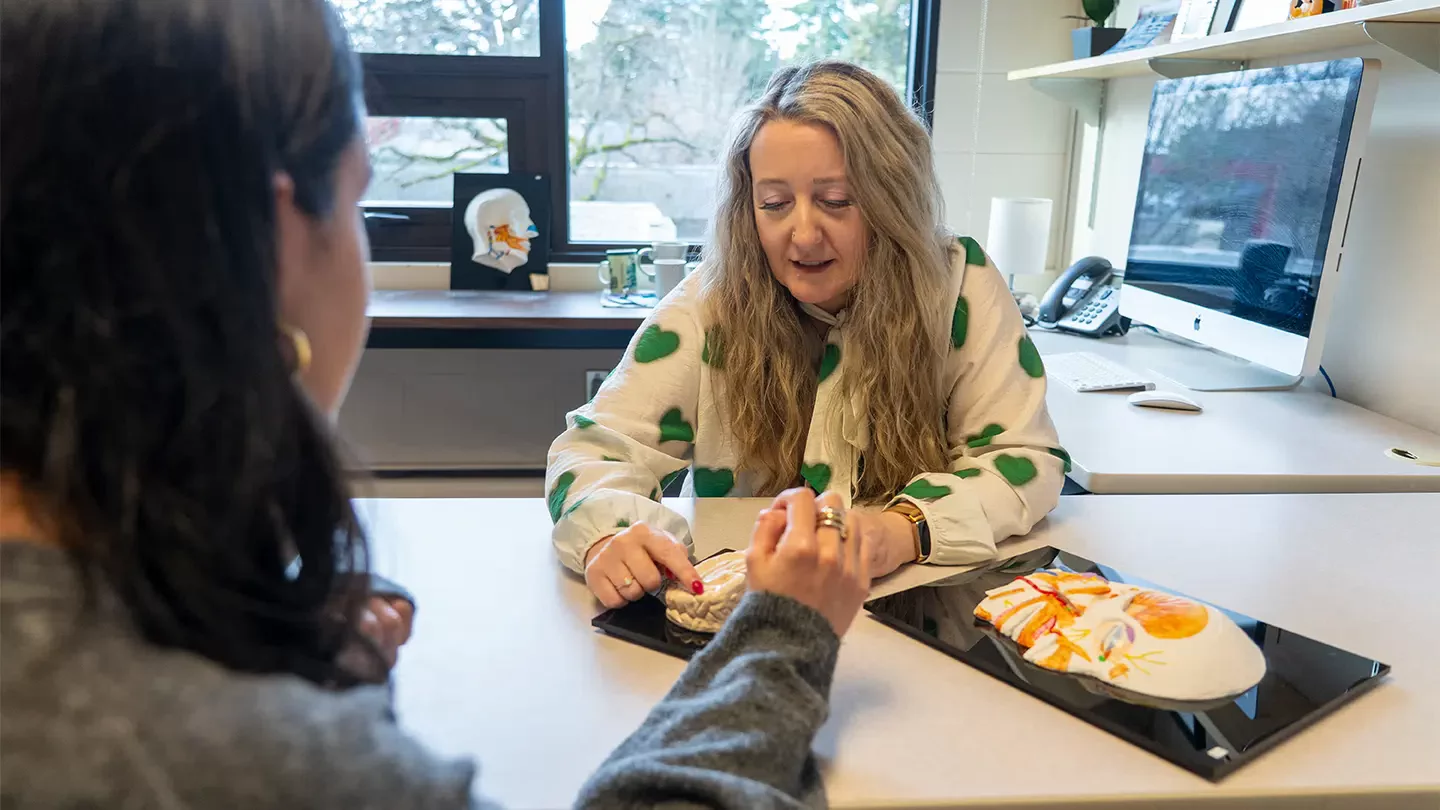
The C-PTSD tool relied on patient-led research, co-created by survivors and Colette Smart's research team, to enhance Island Health care.
“Trauma is having a moment in the public discourse. On one hand, it’s great that we have more awareness about trauma—there is so much shame and stigma, that bringing trauma into the conversation can help survivors come out of the shadows and get the support they need," Colette says.
“But at the same time, there's a lot of misinformation out there; it’s common to see influencers hanging their shingle on being ‘trauma experts’ or sharing content that over-diagnoses trauma when we’re really talking about everyday stressors, as difficult as those may be. That makes it really important to give accurate information. We definitely don’t want people to hide, but we also don’t want people to over-diagnose their issues, either.”
Society is paying a price for undiagnosed and untreated trauma. For example, many struggling with trauma cannot participate in the workforce. There is also an increased strain on social systems like criminal justice, child protection and health care—not to mention community mental health.
increased medical treatment and mental health services
lost productivity and workforce participation
strain on criminal justice and social support systems
Patients lead the way
Grappling with symptoms, Lori Herod was in therapy and desperate to understand why she struggled with so many relationships in her life.
“It’s not me being crazy or weak or lazy—and there’s got to be other people out there,” she recalls.
Lori created Out of the Storm, a website that educates people about C-PTSD and provides a forum for survivors to connect, ask questions and feel less alone. Today, the website connects over 14,000 members from 87 countries through shared experiences.
“Daily living can be very difficult. A lot of us put a mask on, but many can’t even do that. You see that in homelessness, addiction. C-PTSD is definitely a public-health issue, if not a crisis,” Lori says.
Supporting the medical community
Next, Lori looked for a research partner to co-create an educational resource that combined clinical and academic knowledge with survivors' voices on trauma-informed care. During an International Society for Traumatic Stress Studies meeting in 2024, Lori asked the complex trauma special-interest group if anyone was interested in working with her on the project, and Colette immediately put up her hand.
Together they led a team of clinicians, researchers and survivors to conduct a research study. Their goal was to figure out what survivors need in order to experience trauma-informed care. The result was Complex Relational Trauma and Complex PTSD: Closing the Gap in Healthcare.
Our souls are wounded. But when you receive care and understanding, that is healing. Those connections seep into your being. I don't think you ever get rid of C-PTSD, but you can learn to manage it."
Island Health: leadership and support
A vital partner in the project was Island Health. In addition to teaching at UVic, Colette holds the position of Island Health's Research Scholar in Residence for Mental Health and Substance Use. Sitting between academia and health-care service delivery, Colette identifies innovation within research and translates that information into supports for frontline workers.
While there is a growing awareness about trauma-informed care (TIC), the research hasn’t typically included survivors.
“The novel and innovative component of this project is the fact that it was patient-oriented research. Survivors identified that knowledge and training on TIC was needed, but somehow this was not translating to the actual care survivors were receiving. It was a survivor who had the idea for the project, a survivor who was the co-lead, and through the inclusion of a group of separate patient partners, this meant that survivors' voices were centered through the entire process of its development," Colette says.
The resource is online and being rolled out to the mental health and substance use division at Island Health, as well as other health-care teams. So far, the resource has been given to 47 institutions and professional associations in BC, Canada and the United States. Both Lori and Colette are exploring options for promotion, in health sectors and beyond, to help as many people as possible.
It outlines the three elements that contribute to quality care for C-PTSD patients:
therapeutic relationships are essential
healing takes time and patience
create a safe space for people to grow and share
Unfortunately, people everywhere have been exposed to traumatic events. The WHO conducted a mental-health survey in 2025 and found 70% of all adults who responded had experienced at least one type of trauma listedi. Often, health-care workers themselves face traumatic scenarios, making it crucial that they understand C-PTSD and its effects to support their own wellness.
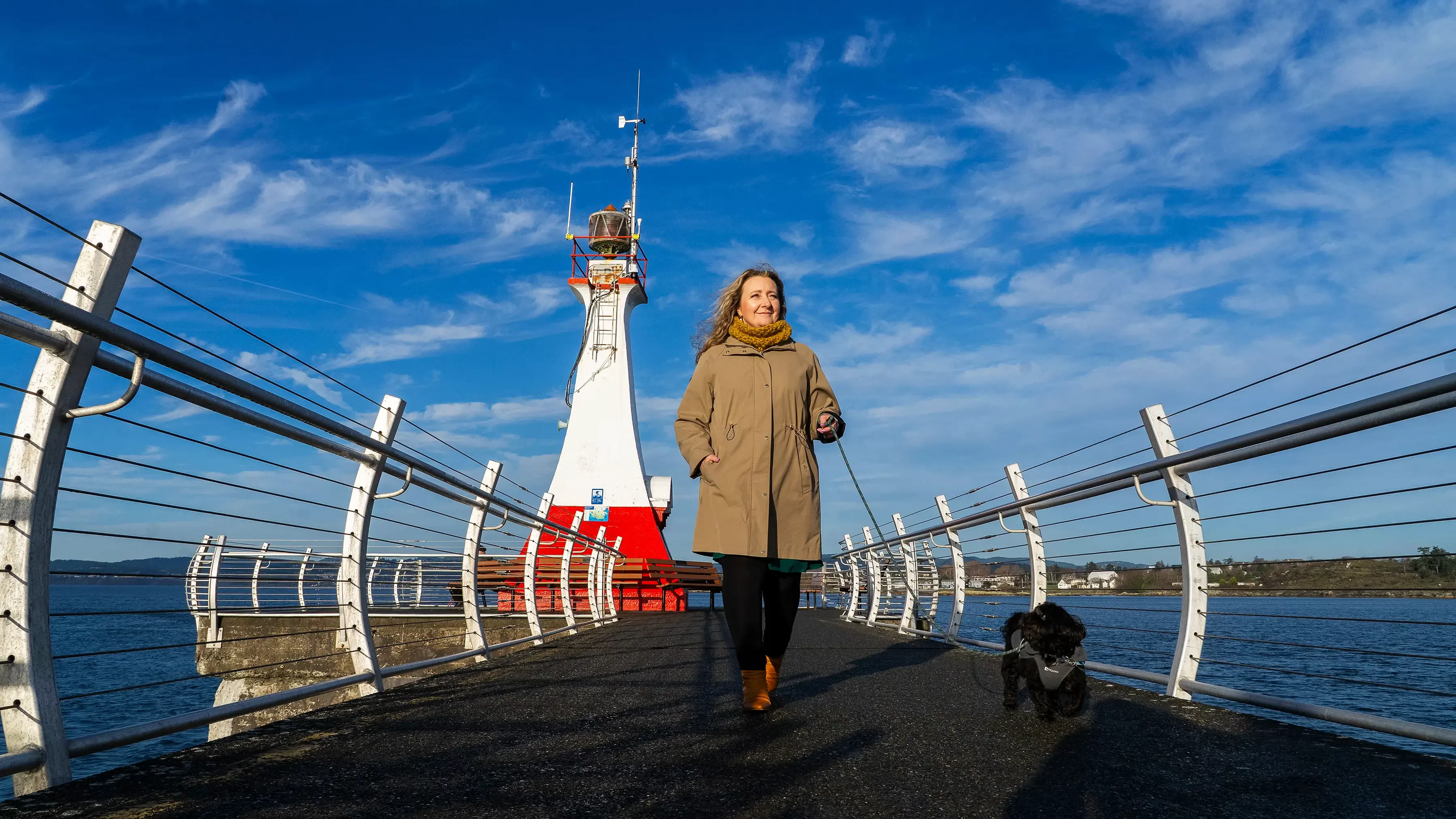
Grounding at Ogden Point
Colette has championed mindfulness to her clients and students long before Instagram and its influencer culture existed. One of the ways she practices mindfulness is by walking in her favourite natural spaces in Victoria. When there is a break in her schedule, you can find her wandering around the Victoria Breakwater at Ogden Point.

She always has support close by: Frank, her four-legged companion and certified therapy dog, was named after the famed psychiatrist and Holocaust survivor Viktor Frankl. Frank joins her on outings wearing a knitted coat to fight off winds whistling in from the Salish Sea. The Breakwater is one of her favourite local places to breathe in fresh air and clear her mind.
“One of the first skills we teach trauma survivors is to ground—we encourage them to feel the earth beneath them, notice what's around them visually, take in the physical sensation of their environment," Colette explains.
"Intuitively, there is something about the land here that is healing. The land is really critical, and my connection to nature is so important. It is what keeps me grounded and balanced in the work I have to do, and is a source of genuine comfort."
Mental health resources
This article discusses trauma and sources of trauma. Please know that support is available. There are many resources and supports at UVic and in our community:
Citations
i R.C. Kessler, B. Ustun (eds): The WHO world mental health surveys. Global perspectives of mental health surveys. Cambridge University Press, New York, First Edition, 2008.
UVic in the community

Territory acknowledgement
We acknowledge and respect the Lək̓ʷəŋən (Songhees and Xʷsepsəm/Esquimalt) Peoples on whose territory the university stands, and the Lək̓ʷəŋən and W̱SÁNEĆ Peoples whose historical relationships with the land continue to this day.