
Hamilton!
May 28, 2026
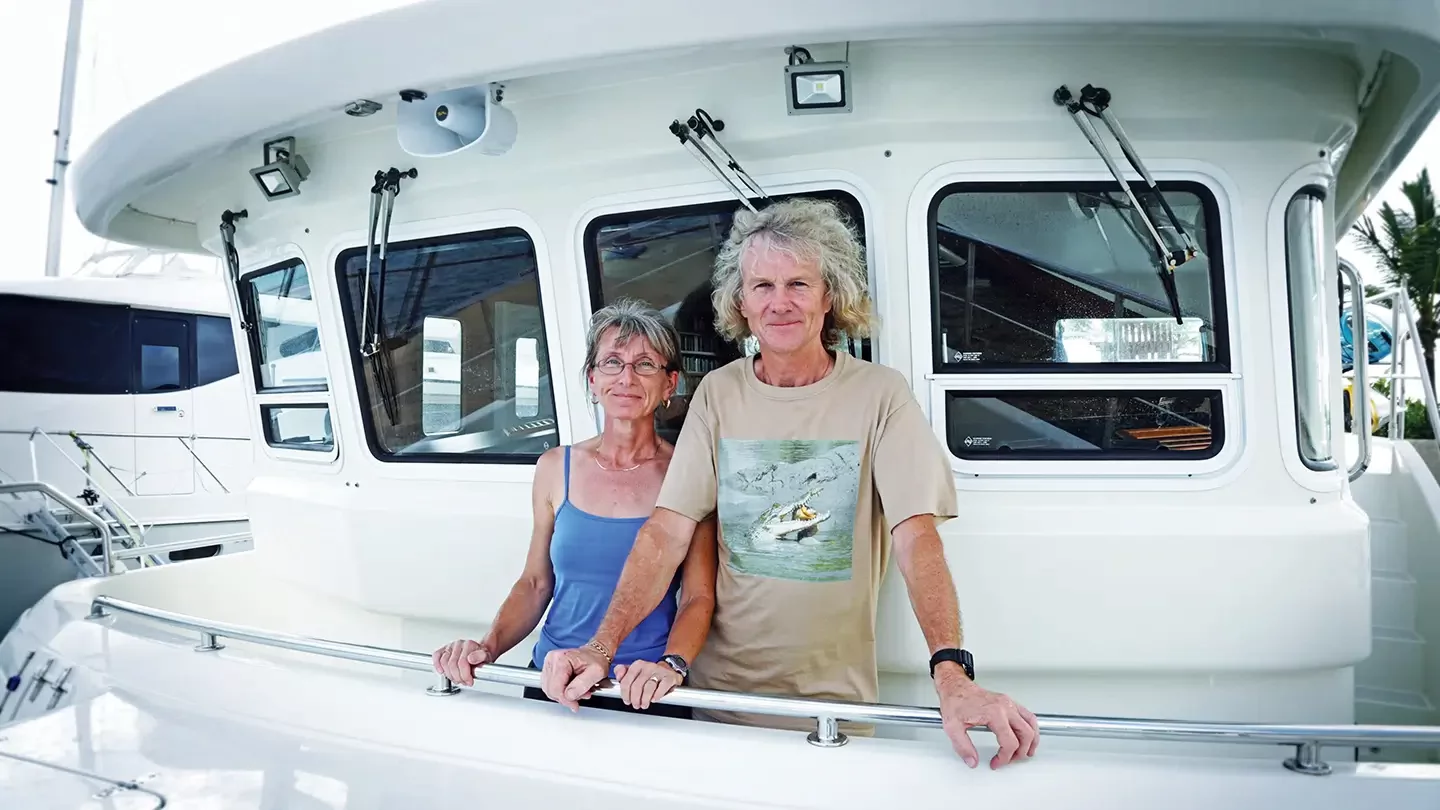
UVic Computer Science alumnus James Hamilton, BSc ’87, fed his dual passions by working as the top engineer for Amazon Web Services—while travelling the world by sea on a trawler yacht, the MV Dirona.
James Hamilton was always innately curious—and a little lucky, as least how he tells it. Growing up, he was sometimes cared for by his maternal grandmother who would allow him to take apart mechanical clocks. He recalls doing this with “great joy.”
“I have to admit, none of them got back together, but I totally learned a ton. It was a great experience,” says Hamilton.
Then, at age five, he experienced university for the first time. His mother worked, and his father was a student at the University of Oregon. Their solution for child care was to have the preschooler hang out at the campus—“the richest environment on Earth,” as Hamilton calls it. His father, who was earning a business degree, would arrange to reunite with him after the class bell.
“And I would meet people, like the computing centre would invite me in and show me changing tapes, and the student press would bring me in to watch them setting type for the student newspaper,” recalls Hamilton, his voice cracking with emotion at the memories.
“I had a physics professor just teaching me why it’s hard for a car to accelerate at more than one ‘G’ and why it’s possible that drag racers do that. What an environment! Some of the smartest people on Earth saying ‘Let’s see if we can teach this kid something.’ It was fun.”
So, that was also lucky. And an early sign that James Hamilton will always make the most of an opportunity to learn. That curiosity and drive to solve problems ultimately led him to become the Senior VP and Distinguished Engineer at Amazon, reaching a summit of cloud computing. Hamilton is recognized as an architect of the massive infrastructure that powers Amazon Web Services and keeps it running smoothly. In a LinkedIn post, one business connection referred to Hamilton as “the Mick Jagger of computing systems.”

From dropout to star student
But before all that, he would return to a university campus. His learning journey in enterprise software started at the University of Victoria’s Computer Science program. But it was not a straight line. Amazingly, Hamilton never completed high school. The rigid, rule-based style of learning just wasn’t for him.
By then, his family was living in Victoria, and after leaving high school he worked as a mechanic. Unlike his grandmother’s clocks, the cars did get put back together—with such competence that the teenaged Hamilton began working on imported cars like Lamborghinis and Maseratis.
His boss at Eurocar, Andrew Hagen, perceived his young employee’s vast potential. Hagen began collecting references on Hamilton’s behalf, telling him, “I’ll make sure you get in… You make sure you try hard.” So, Hamilton became a Computer Science student at UVic.
“It was a super transitional time for me. It almost brings tears to my eyes. Super important in my life. I didn’t actually finish high school. I’m going to university… I’ve never passed grade 11 math or grade 12 math. I’ve never done these things before,” he says, speaking from Amazon’s offices in downtown Seattle.
“So, I’m stepping into this computer science program. I’m taking first-year calculus, I’m taking algebra. And without the commitment of the professors around UVic to answer questions and provide a rich environment and challenge me, and be willing to work with me, no way would I have been as successful as I was, no way. My time at UVic was absolutely transformational.”
On campus, he discovered professors willing to let him follow his curiosity and to answer questions. He became a strong student, earning multiple A+ grades. He is grateful to all his professors. One was David Parnas, a pioneer in applying engineering principles to software—whom Hamilton was able to thank in person during a recent visit to Ottawa.
A fateful algebra exam
At UVic, he realized he could learn and succeed. But something else seismic happened: he met Jennifer, who was also a Computer Science student. They had classes together and conversed occasionally. One morning, they both wrote an algebra exam.
“First-year algebra for someone that didn’t finish high school is totally challenging. And I know I passed that exam. I know I did pretty well on that exam. And so, I’m just smiling ear-to-ear. So, I saw Jennifer at the bus stop, and I said ‘Come on, let’s go to the SUB pub.’ So, we met with a bunch of my friends. I think it was about a 13-hour lunch or something like that. We left around one in the morning.”
They’ve shared their lives ever since, including puzzling through engineering problems together. “Always and in incredible detail. We’ve done it for 44 years. Anything hard one of us is working on, the other one is poking and challenging and questioning and suggesting answers. It’s been that way forever, and it’s still that way today.”

The two also fulfilled a dream to sail around the world in their single-engine yacht, the MV Dirona, a Nordhavn 52. They spent a decade on the sea while he continued to work as a top engineer at Amazon which, he admits, was difficult. He had pondered leaving his post and even mentioned it to his CEO, but ended up continuing his duties with the help of onboard communications equipment. During that time, Hamilton only did three things: worked on engineering problems, fixed the boat and stood watch during the day—a necessity on the open ocean.
At a certain point in the Pacific, the demands of living on the sea were such that Jennifer, who also earned a Bachelor of Science from UVic in 1987, wound down her work to focus on boat duties—so they could live out their dream to travel.
“Because of the nature of the life that we’ve been leading for a long, long time, we like to jam a lot in. The two things we like to do, and we’ve always liked to do, are 1. Travel and 2. Work on engineering problems at work. I love both of those. Not a lot else fits. You’ve got to be selective when there’s more to be done than there are hours in the day. That’s basically what we do.”

Calamity on the sea
Hamilton loved the freedom and flexibility of life on the boat—being able to leave a location at 4 a.m., or decide to stay two weeks longer. Norway, with its mountains and fjords, was a particular favourite. But the voyage was not always smooth sailing.
He recalls one stormy night on the North Atlantic, travelling from Rhode Island to Ireland. The MV Dirona was about 1,200 km offshore. He was awakened by alarms going off. There was a massive leak. The engine room had two feet of water in it. The duo had to battle leaks and try to figure out the cause. “It’s a long deal. It ends up being 11 hours before we had things under control again. And you know, 11 hours when you’re in 20-foot seas and the boat is really active in a big storm. It was challenging.”
Still, it was a short period of distress over a 10-year adventure. These days, the couple spends more time on land, living in a Seattle apartment. Hamilton can glimpse their home from his office at Amazon. “I’m now a block-and-a-half from work rather than halfway around the Earth,” he muses.

Hamilton, who also earned a Master of Mathematics at Waterloo University in 1997, held positions at IBM and Microsoft before landing at Amazon, where he now works across the company. He spends his time on his own projects, advising on other endeavours in the company, or addressing specific problems the CEO brings to him.
He holds more than 200 patents. His most valued discoveries are the simple solutions that move the needle for customers—the ones that seem obvious and cause people to ponder how it could even be a patent. “Of course, that’s the way you would do that. Those are the ones that are great. The ones that are ‘of course.’”
He’s not certain what it takes to be good at what he does. “Things that really help is curiosity, a real hunger to dig into details of everything around you. A drive for simplicity. And a commitment to find solutions that really make a difference for customers.”
Super curious, hungry to learn
A key step in his journey as a learner and engineer was his time at UVic. He deeply appreciates the influence of professors such as Ali Shoja, Pauline van den Driessche, Nigel Horspool, Michael Levy, Frank Ruskey and John Ellis.
“They spent time with me. Because I’m super curious, I’m super hungry to learn, they allowed me to take the education to a higher level… I always wanted to dig deeper, and these folks always had time to let me dig deeper with them,” he says. “It made a huge difference for me.”
Hamilton stresses that as a society, we’re on the cusp of great change and possibility.
“We’re at a point in time where machine learning is changing pretty much every business on Earth. There’s innovation happening in insurance, in car sales, innovation happening in molecular investigations in bio pharma—across the board we’re at a time when there’s more change and more is possible than I’ve ever seen at any other time in my lifetime.”
Machine learning means everything is fluid and possible. “And by fluid, I mean you can actually make ideas happen in so many different domains so rapidly right now. At the same time, it’s super exciting, and also a little scary, because with great change comes sometimes surprising outcomes—and sometimes there’s things that need to be learned.”
Many innovations that have seemed unaffordable or too difficult are now looking possible, he adds. “We’re going to see more successful start-ups and more innovation. We’re going to see more change in the next five years than we’ve seen in the previous 50.”
His own personal mantra is simple: “Work with great people.”
“Some people work really hard to get titles and some people are really hungry for promotion or other advantages. I’m totally convinced: work with great people, you end up delivering more, you end up learning more, you end up on more successful projects,” says Hamilton. “And every company on Earth loves hiring successful people. And so, work with great people and everything else follows.”
—Jenny Manzer, BA ’97
This article appears in the UVic Torch alumni magazine.
For more Torch stories, go to the UVic Torch alumni magazine page.