
Dr. Neilesh Bose
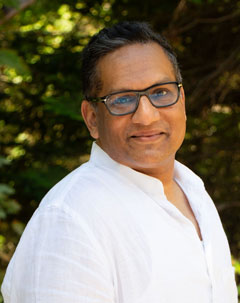
CAPI Senior Research Fellow, IPSFC Fellow
Professor, History
- Contact:
- nbose@uvic.ca
- Area(s) of expertise:
- Project lead: Global South Colloquium (current); South Asia Global Forum (past)
Neilesh Bose is a UVic Professor of History and an IPSFC Fellow. His research interests include modern South Asia history, global history, and cultural and intellectual history.
Bio
Neilesh Bose is a cultural historian of modern South Asia with interests in colonial India, nationalism, religion, and migration, with a focus on India and Bangladesh. He is the author of two academic monographs on aspects of religion and nationalism in nineteenth and twentieth century South Asia. He holds a particular interest and expertise in the history, culture, and politics of Bengali speaking people in West Bengal, India, and Bangladesh, as well as the vast Bengali diaspora. As a professor of history at the University of Victoria, he teaches classes in modern South Asian history, world history, and comparative histories of decolonization.
Research Partners
- National Law School of India, Bangalore, India
- Rohingya Cultural Memory Centre, Cox's Bazaar; Research Initiatives Bangladesh (RIB), Bangladesh
- Fortify Rights, Thailand
IPSFC Research Project
Forced Displacement in the Indo-Pacific: The Case of Rohingya Refugees in Global Context
This project investigates forced displacement in the Indo-Pacific region with a focus on the case of the Rohingya refugees and their current condition in India, Bangladesh, and Thailand. This project focuses on how NGOs as well as states in the region, with a focus on these three nation-states, from large powers like India to states like Bangladesh and Thailand, which both house large numbers of refugees, are currently responding to the situation. Between 2018 and 2024, Canada pledged nearly $600 million CAD to assist in refugee resettlement of Rohingya in Bangladesh. In 2025, Canada announced a pledge of $56 million CAD to further assist Bangladesh, which houses one of the largest sets of refugee camps in the world for the Rohingya. This research will result in both an academic book chapter about forced displacement in the Indo-Pacific for an edited volume in progress as well as a working paper designed for the Canadian government. Additionally, this project will develop a network of scholars, NGO workers, and government officials working on this topic in the Indo-Pacific.