
About the Centre
Mandate
Through the continued excellence of its research and programming, CAPI will be recognized as the pre-eminent Asia-Pacific focused academic centre globally.
The Centre will engage with institutions, civil society and leading scholars at the University of Victoria and across the world to facilitate meaningful relationships that will make a difference.
By providing a supportive environment for scholarly excellence and community engagement, CAPI will deepen the connection between the University of Victoria and the Asia-Pacific region.
Through the work of CAPI’s researchers and programming, CAPI will be a catalyst for the creation, recognition and dissemination of knowledge concerning issues affecting the region.
Values
- We are welcoming, engaging, supportive, collaborative, community-oriented, respectful and entrepreneurial.
- We value academic freedom and autonomy, creativity, inclusivity, intellectual and ethical integrity, courage, collaboration and diverse perspectives.
- Our research is open, interdisciplinary, innovative, co-creative, participatory, ethical, visionary, transformative, and impactful.
Goals
Our five primary goals are:
- Leadership in Research: CAPI inspires creative, innovative research engaging a diverse community on complex issues in Asia.
- Research Community: CAPI works with researchers and partners in a spirit of creativity and critical engagement.
- ASIA@CAPI: CAPI is the University’s intellectual home for everything Asia-related.
- Inspired People: CAPI attracts a diverse, dynamic, and talented group of faculty, students, and staff.
- Resource Sufficiency: CAPI has reliable and sufficient resources that it uses effectively to meet the goals of this plan.
Strategic plan & annual report
History
In 1988, the Centre for Asia-Pacific Initiatives (CAPI) became the first Senate-approved research centre at the University of Victoria. Recognizing the importance of the Asia-Pacific region to Canada, the concept of a centre focusing on Asia-Pacific issues was given financial support by the Dorothy and David Lam Foundation, the Federal Secretary of State and the Provincial Government of British Columbia. Over three decades later, the Asia-Pacific region not only continues to of importance to Canada, but has grown in its significance.
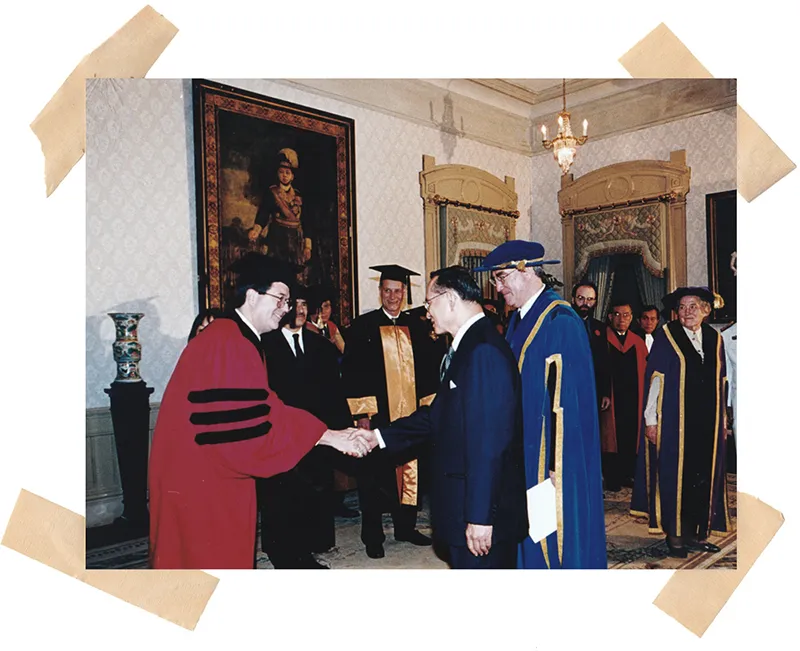
CAPI was front and centre on November 5th, 1999, when UVic conferred the Degree of Honorary Doctor of Science upon His Majesty King Bhumipol Adulyadej of Thailand at Chitralada Royal Villa in Bangkok. Above, CAPI Director William Neilson shaking hands with His Royal Highness; UVic President David Strong is to the right of the King in blue and Chancellor Norma Mickelson is at far right, in purple. Also in attendance were long-time CAPI Associate/Geography professor Phil Dearden (obscured behind Dr. Neilson), Khun Anand Panyarachun (another UVic honourary degree recipient, for whom CAPI's Anand scholarship is named), and CAPI Associate and prominent Thai businessman Jingjai Hanchanlash (second from right).