This website stores cookies on your computer. These cookies are used to collect information about how you interact with our website and allow us to remember your browser. We use this information to improve and customize your browsing experience, for analytics and metrics about our visitors both on this website and other media, and for marketing purposes. By using this website, you accept and agree to be bound by UVic’s Terms of Use for web and social media privacy.  If you do not agree to the above, you can configure your browser’s setting to “do not track.”

Skip to main content

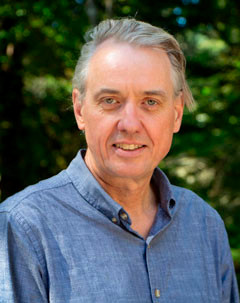
Dr. Falk Herwig

CAPI Associate, IPSFC Fellow

Professor, Physics and Astronomy

Status:
CAPI Associate since 2026

Falk Herwig is Professor of Astrophysics in the Department of Physics and Astronomy at the University of Victoria and Director of the UVic Astronomy Research Centre.

Bio

Falk Herwig's research uses three-dimensional hydrodynamic simulations to study the late evolutionary stages of massive and evolved stars, the mixing and nuclear processes that shape supernova progenitors, and the origin of the chemical elements. He co-founded the NuGrid international nuclear-astrophysics collaboration and leads digital-research-infrastructure projects including the AstroHub virtual research platform. He has supervised numerous graduate students and postdoctoral fellows. His research is supported by an NSERC Discovery Grant, international funding sources and national and international high-performance-computing allocations.

Research Partners

Macquarie University, Monash University and University of Sydney  - Australia
National Astronomical Research Institute of Thailand (NARIT) - Thailand
Meiji University, Kyoto University, and University of Tokyo/ICRR  - Japan


IPSFC Research Project

Asia-Pacific Stellar Astrophysics Research Alliance (APSARA)
 
Falk Herwig's IPSFC Faculty Fellowship builds the Asia-Pacific Stellar Astrophysics Research Alliance (APSARA), a research network connecting the University of Victoria with partner institutions in Australia, Thailand, and Japan. The project closes a feedback loop between predictive three-dimensional stellar simulation and multi-wavelength observation of supernova remnants: three-dimensional pre-supernova models developed at UVic feed into explosion simulations at Monash University, are tested against infrared imaging of supernova dust from NARIT (Thailand) using the James Webb Space Telescope, and against X-ray observations from Meiji and Kyoto Universities using the XRISM mission. A second research line couples three-dimensional simulations to asteroseismology with the University of Sydney and NARIT. Alongside the science, the fellowship builds people-to-people ties through graduate-student engagement, a workshop and school for early-career researchers hosted at NARIT, and scoping of collaboration on AI infrastructure for research with partners in Australia, Japan, and Thailand.