
CAPI Research Travel Fellowships
A CAPI Research Travel Fellowship valued at $2,500 is available on an annual basis to support graduate student research in the Asia-Pacific region:
Closing date: 31 March at 4pm Pacific Time each year
Contact: CAPI at 250-721-7020 or capi@uvic.ca for more information.
Eligibility
To be eligible applicants must:
- be enrolled in a graduate or undergraduate program at UVic during the year of application;
- be returning to UVic for further study after going abroad;
- have a B+ average over the most recent 15 units completed.
The CAPI Research Travel Fellowship is restricted to Master or PhD level candidates. Applicants must have the written approval of their Supervisor.
Terms
- Individuals who accept this Fellowship are responsible for arranging their own: visas/permits as required; field work; health insurance coverage; and accommodation. CAPI accepts no responsibility other than disbursal of the award.
- Funds are awarded as a reimbursement for travel costs. Upon returning to UVic, the student must provide airline receipts, boarding passes, local transport receipts etc. to CAPI; submit a report or article for the CAPI newsletter; and, if requested by CAPI, present a CAPI lunch time seminar.
- Fellowships are awarded solely at the discretion of the Selection Committee, whose decision is final.
- The Fellowships should be used within one year of the year of the date they are awarded.
How to apply
A complete application should include:
- A completed application form
- A copy of your resume
- An up-to-date copy of your transcript (unofficial versions are fine for the application stage)
- For the CAPI Research Travel Fellowship, a two-page description of your proposed research project and activities, AND a letter of support from your Faculty Supervisor
Applications must be submitted electronically by email.
Please note: Late or incomplete applications will not be accepted.
Current recipient
Kalpana Jha 2026
Project title: Cross-Border Networks: A Study of the Nepal–India Border
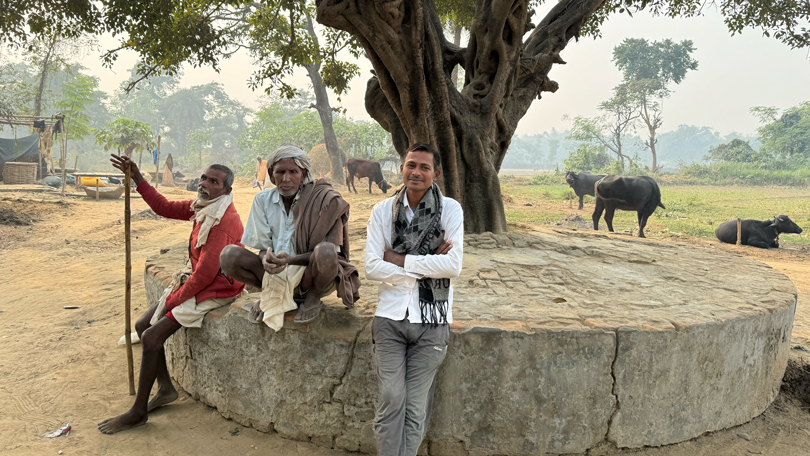
Kalpana Jha won a CAPI Research Fellowship which which supported her research trip to conduct interviews with key local actors across India-Nepal border.
Kalpana's research argues that borderlands are not isolated spaces but remain continuously connected across political boundaries. It challenges traditional views of territoriality as mere control by highlighting “counter-control,” seen in the natural movement of people across borders. This mobility both breaks down strict territorial limits and reshapes how space is understood. The study focuses on these dynamics in the Koshi plains along the India–Nepal border, specifically between Nepal’s Saptari district and India’s Supaul district.
Pictured: The people sitting under the tree are three local men who Kalpana encountered as she looked for the border. "I ended up having a casual conversation. I asked them where the border was. They replied, 'We are sitting on it right now! '"
The people Kalpana encountered during her research trip all provided important insights into borderland lives and cross-border community relations - how changing border control policies directly interrupt the everyday lives of people living on the borderlands.