
2026 Speakers
Jamison Green - Celebrating Ten Years of Distinguished Speakers
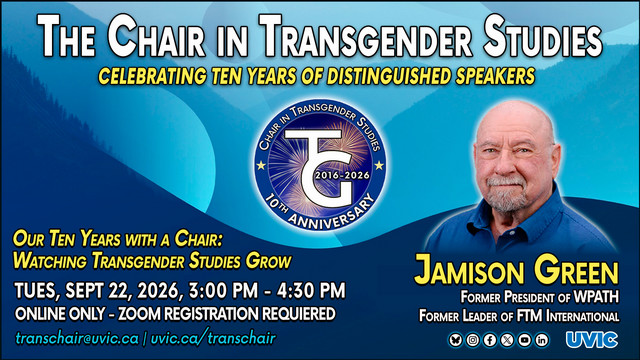
JAMISON GREEN
OUR TEN YEARS WITH A CHAIR:
Watching Transgender Studies Grow
Tuesday, September 22, 2026
3:00 PM - 4:30 PM PDT
On Zoom
This talk will explore the proliferation of gender and transgender studies programs and publications, as well as the artistic and political evolution of the transgender community from a birds-eye view and with an historical perspective, as a way of expressing gratitude for the work accomplished by the Chair and Archives at UVic, acknowledging the inspiration and support the Chair has offered to so many people, and expressing hope for the future of the academic field and our broader communities.
Jamison Green, best known for his award-winning memoir, Becoming a Visible Man (Vanderbilt University Press, 2020/2004), has championed LGBTQ+ civil rights, health, and social safety for 50+ years. After earning an MFA in fiction at the University of Oregon (1972), he found work in construction as a laborer, then in technical publications with several major corporations, in roles from individual contributor to corporate vice president. He transitioned from female to male in 1988, led the nonprofit educational groups FTM International, Inc., and the World Professional Association for Transgender Health, and served on other boards of directors, notably IFGE, the HRC Business Council, and The Intentional Man Project. He earned a Ph.D. in Equalities Law from Manchester Metropolitan University (2011), and is a member of the National Trans Bar and the National LGBTQ+ Bar Associations. He has appeared in over a dozen documentary films (and as himself in "Sense8") and has delivered talks on transgender issues in 23 countries. In addition to numerous publications in professional and scholarly journals and fiction and nonfiction anthologies, Jamison is also a co-editor and co-author of A History of Transgender Medicine in the United States: From Margins to Mainstream, SUNY Press (2025).
Avery Dame-Griff - Fellowship Recipient
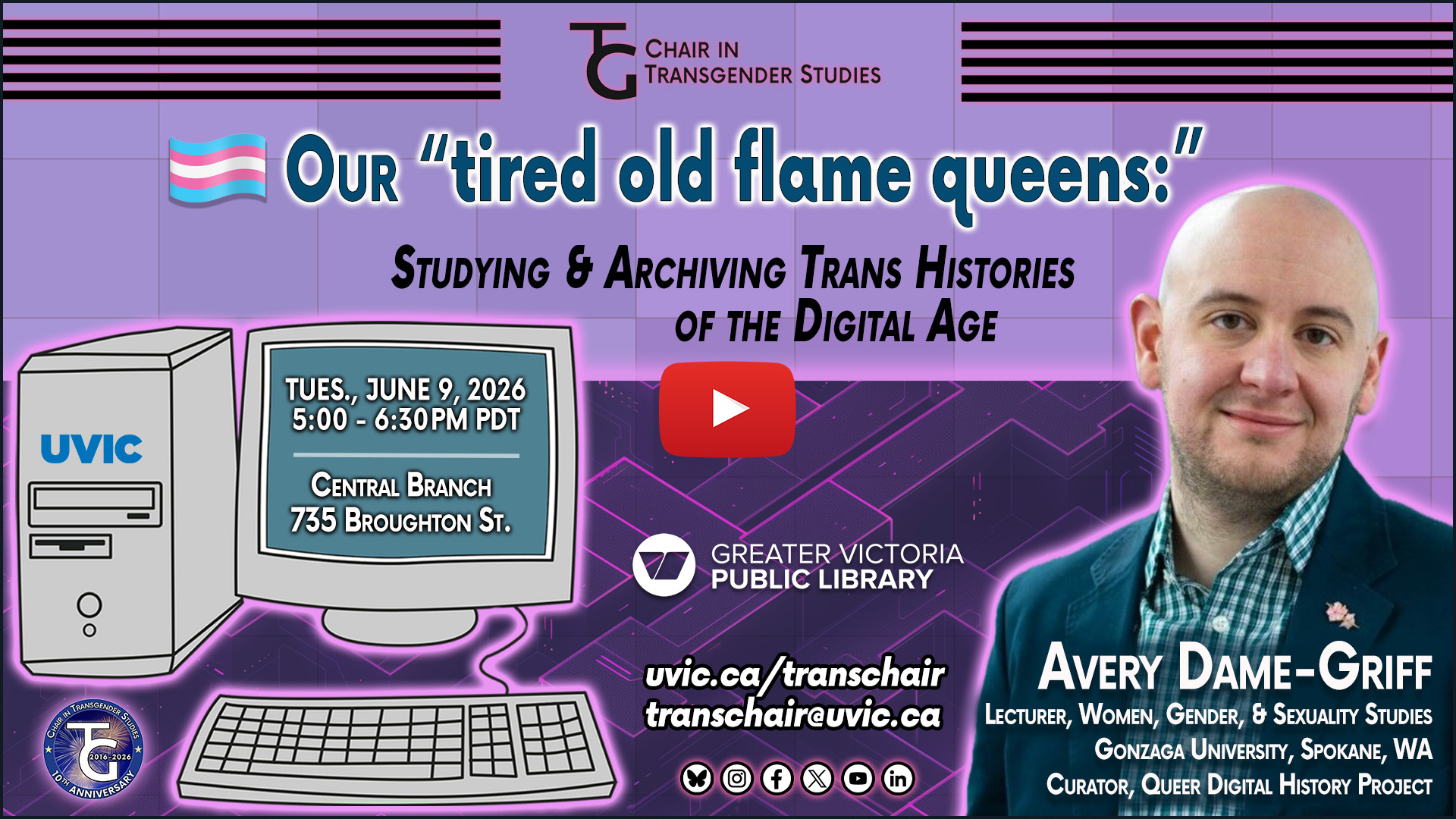
Avery Dame-Griff
Our “tired old flame queens:”
Studying and Archiving Trans Histories of the Digital Age
FREE DOWNTOWN TALK!
Tuesday, June 9, 2026
5:00 PM - 6:30 PM PDT
Central Branch - Greater Victoria Public Library
735 Broughton, Victoria, BC & Online (Zoom)
735 Broughton, Victoria, BC & Online (Zoom)
Like all social movements, internal debate has been a hallmark of formal transgender organizing since its beginning. Who “belongs” within communities? What should we call ourselves? What are the most effective political tactics for reaching the public and policy makers? With the rise of the internet, though, discussions previously confined to letter columns and in-person committee meetings moved online. There, posts meant for like-minded audiences not only spread far beyond their immediate context but also have a much longer and more visible afterlife with the rise of search engines. Arguments made in the heat of the moment—especially when made with an old name or company email attached—can come back to haunt posters long after.
In this talk, I'll explore how historians and archivists can adapt to these changes through the case study of an early 2000s multi-year flame war between two transgender activists and well-known posters on Usenet, an early decentralized network online. What began in the transgender-specific corners of Usenet soon sprawled far beyond to involve mentalists, magicians, and eventually the American Tea Party movement. As this case shows, contextualizing born-digital communication at the local, network, and community level is key to both historical research and archival preservation, particularly when determining access restrictions—including if such objects should be preserved at all.
In this talk, I'll explore how historians and archivists can adapt to these changes through the case study of an early 2000s multi-year flame war between two transgender activists and well-known posters on Usenet, an early decentralized network online. What began in the transgender-specific corners of Usenet soon sprawled far beyond to involve mentalists, magicians, and eventually the American Tea Party movement. As this case shows, contextualizing born-digital communication at the local, network, and community level is key to both historical research and archival preservation, particularly when determining access restrictions—including if such objects should be preserved at all.
Avery Dame-Griff is a Lecturer in Women, Gender, and Sexuality Studies at Gonzaga University and author of The Two Revolutions: A History of the Transgender Internet (NYU Press, 2023). He founded and serves as primary curator of the Queer Digital History Project (queerdigital.com), an independent community history project cataloging and archiving pre-2010 LGBTQ spaces online.
Joanna Harper - Lansdowne Lecturer
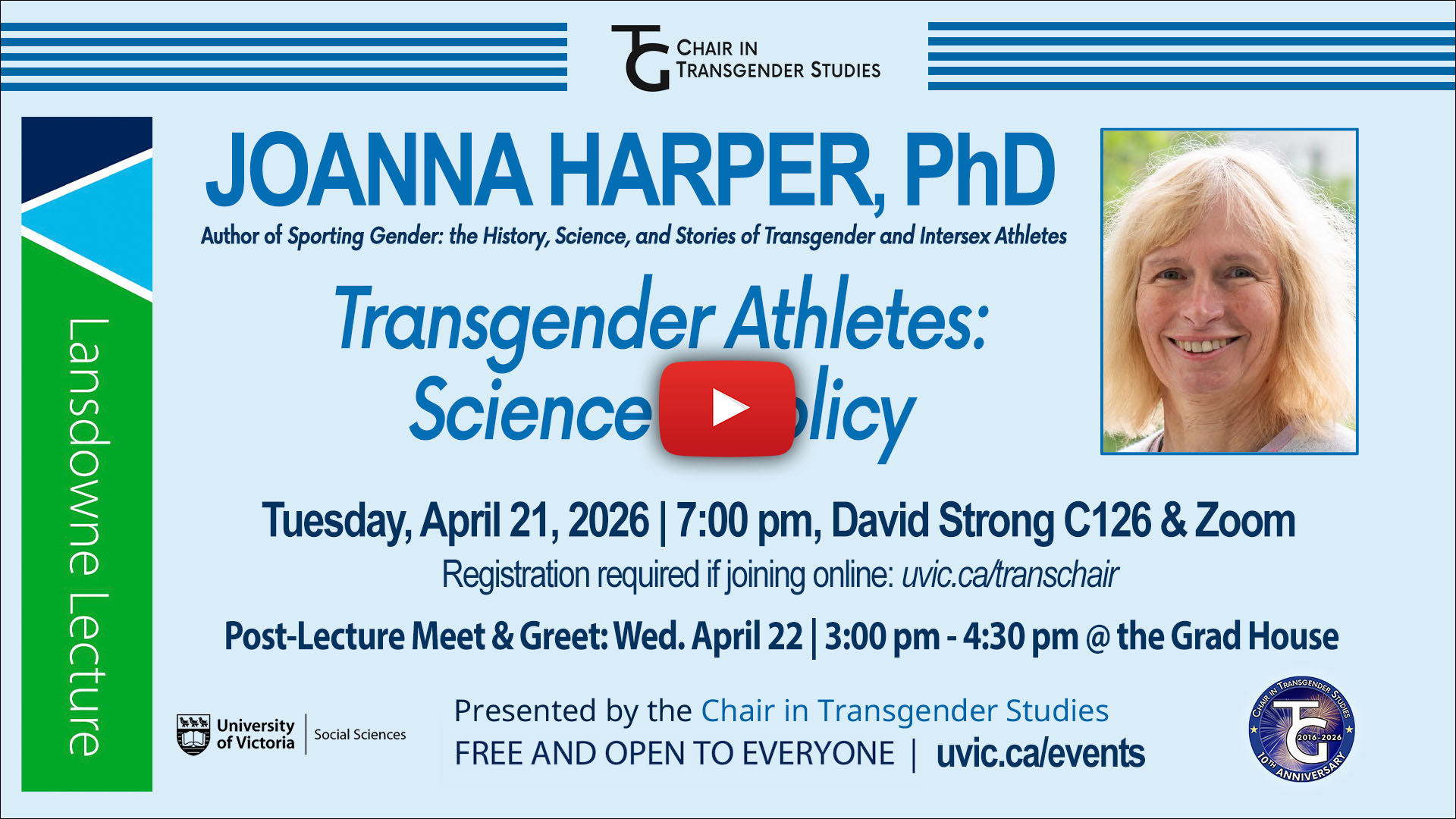
Joanna Harper, PhD
Author of Sporting Gender: The History, Science, and Stories
of Transgender and Intersex Athletes
TRANSGENDER ATHLETES:
Science & Policy
Tuesday, April 21, 2026
7:00 PM - 8:30 PM PDT
UVic, David Strong C126 & Online
MEET & GREET
Join Dr. Joanna Harper for an informal drop-in meet & greet
Wednesday, April 22, 2026
3:00 PM - 4:30 PM
The Grad House (in person only)
Thank you to UVic's Faculty of Social Sciences
and the Lansdowne Lecture Series for supporting this talk
and the Lansdowne Lecture Series for supporting this talk
Despite the fact that transgender athletes are highly under-represented, there is much controversy over the inclusion of trans women in the female category of sports. This talk will start with a look at the complexity of sexual biology, and a brief overview of transgender terminology.
The talk will examine a few population studies to test the hypothesis that trans women will take over women’s sports if they are allowed to compete with cisgender women. The main portion of the presentation will examine published studies on transgender athletes and will also look at some studies on athletic performance in non-athletic trans people. Data from a meta-analysis which is under peer review will also be presented. Some suggestions for policy on transgender athletes will be presented along with the examination of some recent trends in policy.
The talk will examine a few population studies to test the hypothesis that trans women will take over women’s sports if they are allowed to compete with cisgender women. The main portion of the presentation will examine published studies on transgender athletes and will also look at some studies on athletic performance in non-athletic trans people. Data from a meta-analysis which is under peer review will also be presented. Some suggestions for policy on transgender athletes will be presented along with the examination of some recent trends in policy.
Dr Joanna Harper earned her PhD in exercise science from Loughborough University in January 2024. Her area of study was the performance of transgender athletes. She recently completed a position as a post-doctoral scholar at Oregon Health & Science University and has started a position at the International Centre for Olympic Studies at Western University in London, Ontario, Canada.
Dr Harper has published several papers in peer-reviewed journals on transgender athletes. Data gathered at Loughborough University has yielded two published studies: a longitudinal study on the effects of gender affirming hormone therapy on the performance of transgender athletes and a systematic review of hormone-based changes in non-athletic transgender women. Dr Harper had previously published the first peer-reviewed study examining the performance of transgender athletes. She is the author of the Rowman and Littlefield book Sporting Gender: The history, science, and stories of transgender and intersex athletes.
Dr Harper has worked closely with international and national sports-governing bodies as they grapple with the complex issues surrounding eligibility policy for transgender and intersex athletes, including the International Olympic Committee, World Athletics, Union Cycliste Internationale (UCI), and World Rowing. She speaks frequently at international meetings and symposia on the topics of transgender and intersex athletes.
Dr Harper’s interest in transgender athletic performance grew out of her own gender transition and the subsequent speed loss that she encountered as a sub-elite distance runner. Prior to her late-life career change, Dr Harper worked for several years as a medical physicist. She has a master’s degree in medical physics and an undergraduate degree in physics; both earned at Western University.
Kai Muir - Scholarship Recipient
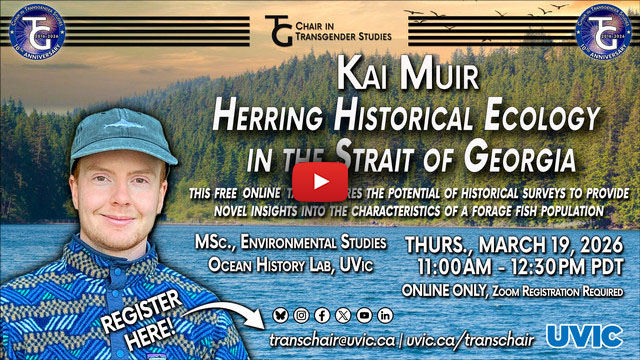
Kai Muir
Herring Historical Ecology in the Strait of Georgia
Thursday, March 19, 2026
11:00 AM - 12:30 PM (PDT)
Online ONLY
Without an identified use case for early biological survey data, these historical records are vulnerable to fading into obscurity while fisheries managers prioritise the development and application of modern surveying techniques. In this research, I demonstrate the potential of historical surveys to provide novel insights into the characteristics of a forage fish population. Drawing from archived surveys (1915-1939) and a federal biosample database (1946-2024), I present a 109-year analysis of trends in the age composition, length composition and growth rate of Pacific herring populations across seven management areas in the Strait of Georgia, British Columbia. To provide historical context to the trends observed in the archival data, I accompany my analysis with a qualitative study of coverage of the herring fishery from the industry journal Pacific Fisherman (1903 -1951). This body of work aims to engage with present uncertainty over the appropriate management of Pacific herring stocks by expanding our understanding of the current status of these populations in relation to their historical counterparts.
Kai Muir is an Environmental Studies MSc. student in the Ocean History Lab at UVic. His master’s research is focused on assessing the potential of historical biological surveys and industry periodicals to inform modern management of Pacific herring stocks in the Strait of Georgia. This is his second major research project with the Ocean History Lab; in 2023, he completed an undergraduate Geography honours thesis quantifying the catch of Pacific cod in the Gulf of Alaska throughout the rise and fall of the early-20th century salt cod industry. Outside of his historical research, Kai enjoys spending time in the field volunteering for local marine monitoring initiatives.
Karina Villaluna - Alumna Speaker
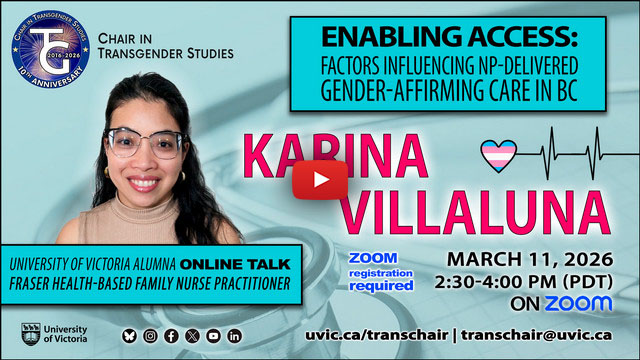
Karina Villaluna
Enabling Access:
Factors Influencing NP-Delivered Gender-Affirming Care in BC
Factors Influencing NP-Delivered Gender-Affirming Care in BC
ONLINE TALK
Wednesday, March 11, 2026
Wednesday, March 11, 2026
2:30 PM - 4:00 PM (PDT)
The aim of this presentation is to share the results of the cross-sectional study titled NP-BRIDGE. The study was conducted to understand the facilitators and barriers to providing gender-affirming care as experienced by nurse practitioners (NPs) in British Columbia (BC).
Karina Villaluna (she/her) is a Fraser Health-based Family Nurse Practitioner and University of Victoria alumna. She provides comprehensive longitudinal primary care for patients of all ages with a specialized focus in the provision of gender-affirming healthcare. Karina is passionate about providing compassionate, continuous, and inclusive care that is as scientifically grounded as it is deeply personal.