
Dr. Allan Mitchell
Professor
English
- Contact:
- Office: CLE C331 amitch@uvic.ca
- Credentials:
- BA (Victoria), MA and PhD (Dalhousie)
- Area(s) of expertise:
- Medieval literature
Allan Mitchell has been with the department since 2006. His primary interests lie in medieval poetics, rhetoric, philosophy, cosmology, and the history of science and technology where they overlap with English literature of the fourteenth and fifteenth centuries. He is the author of Instrumentality: On Technical Objects and Orientations in the Later Middle Ages (2024) and Becoming Human: The Matter of the Medieval Child (2014). Dr Mitchell co-organized symposia on the Critical/Liberal/Arts at UC Irvine and CUNY, later documented in postmedieval: a journal of medieval cultural studies 6.4 (2015). He has given plenary talks at the London Chaucer Conference (University of London, 2015) and the Canada Chaucer Seminar (University of Toronto, 2011), and he delivered the inaugural lecture in the Oecologies Speaker Series (University of British Columbia, 2013). Before coming to Victoria, Dr. Mitchell was appointed permanent lecturer at the University of Kent, Canterbury, and he held a postdoctoral fellowship at the University of Bristol.
Instrumentality: On Technical Objects and Orientations in the Later Middle Ages
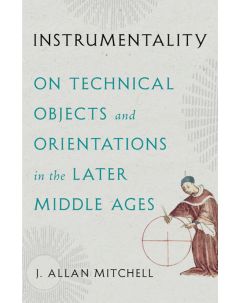
University of Minnesota Press, 2024.
From medieval to modern, exploring instrumental attitudes toward physical gadgets, diagrams, concepts, methods, and disciplines.
Becoming Human: The Matter of the Medieval Child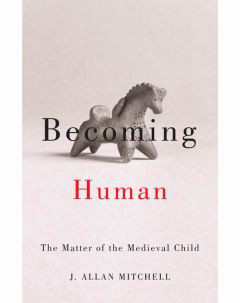
University of Minnesota Press, 2014
Human identity was articulated and extended across a wide range of textual, visual, and artifactual assemblages from the twelfth to the fifteenth centuries. Mitchell shows how the formation of the child in particular expresses a manifold and mutable style of being. To be human is to learn to dwell among a welter of things. A searching and provocative historical inquiry into human becoming, the book presents a set of essays on embryology and infancy, play and games, and manners, meals, and other messes. While it makes significant contributions to medieval scholarship on the body, family, and material culture, Becoming Human theorizes anew what might be called a medieval ecological imaginary. Mitchell examines a broad array of phenomenal objects - including medical diagrams, toy knights, tableware, conduct texts, dream visions, and scientific instruments - and in the process reanimates distinctly medieval ontologies. In addressing the emergence of the human in the later Middle Ages, Mitchell identifies areas where humanity remains at risk. In illuminating the past, he shines fresh light on our present.
Ethics and Eventfulness in Middle English Literature
Palgrave Macmillan, 2009 (The New Middle Ages)
Medieval writers were fascinated by fortune and misfortune, yet the critical problems raised by such explorations have not been adequately theorized. Mitchell invites us to consider these contingencies in relation to an "ethics of the event."
His book examines how Middle English writers including Chaucer, Gower, Lydgate, and Malory treat unpredictable events such as sexual attraction, political disaster, social competition, traumatic accidents, and the textual condition itself - locating in fortune the very potentiality of ethical life.
John Lydgate: The Temple of Glas
Medieval Institute Publications, 2007
A new edition of Lydgate's Temple of Glas. An extremely elusive and suspenseful dream vision - and for that reason a highly sensational erotic poem that demands close attention to formal detail and the dynamic way in which meaning unfolds.
Ethics and Exemplary Narrative in Chaucer and Gower
Boydell & Brewer, 2004 (Chaucer Studies)
Why do medieval writers routinely make use of exemplary rhetoric? How does it work, and what are its ethical and poetical values? Borrowing from recent developments in ethical criticism and theory, this book addresses such questions by reconstructing a late medieval rationale for the ethics of exemplary narrative. Mitchell argues that Chaucer's Canterbury Tales and Gower's Confessio Amantis attest to the vitality of a narrative - rather than strictly normative - ethics that has roots in premodern traditions of practical reason and rhetoric. Chaucer and Gower are shown to be inheritors and respecters of an early and unexpected form of ethical pragmatism - which has profound implications for the orthodox history of ethics in the West.