
Ramage: Engineering grad contributes to massive computer grid
- Robie Liscomb
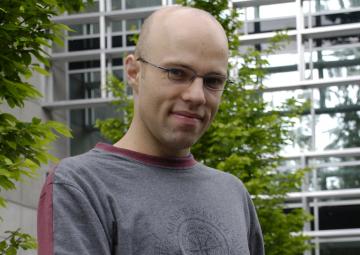
When particle physicists start crunching the masses of data generated by the Large Hadron Collider at CERN in Geneva, computer engineering undergraduate student Simon Ramage should breathe a sigh of satisfaction.
Winner of this year’s IEEE Victoria Section Gold Medal in Computer Engineering, Ramage contributed—albeit in a small way—to cutting edge grid computing research related to the massive computer grid scientists will use to analyze the results of high-energy proton collisions, revealing new secrets about the nature of matter.
Ramage, from Okotoks, AB, came to UVic from Camosun College via the Bridge Program, which credits previous college and work experience, allowing students to condense five years of study into three. During his years at UVic he was supported by several scholarships, including the Canadian Satellite Users Association Scholarship, the Baynes Award in Engineering, the Charles Humphrey Memorial, as well as President’s and Dean’s Entrance Scholarships.
Through engineering co-op, Ramage landed a placement in UVic’s Department of Physics and Astronomy, where he worked with a grid computing research team. Computer grids consist of many individual computers linked together, providing massive computational power that far surpasses that of supercomputers. Ramage was researching new ways of implementing computer grid middleware with Web Services.
The grid developed at UVic is joining forces with that at CERN to handle the huge amounts of data that will result when the Large Hadron Collider goes into operation later this year.
“That placement provided me with a strong technical foundation and was a great opportunity to work with a team of graduate students,” says Ramage.
He also served a work term with Intel in Vancouver, where he contributed to research and development of flash memory technology. “I can’t say enough good things about my placement at Intel,” says Ramage. “They treated me like I was a regular employee and allowed me to contribute to several important projects.”
After graduation, Ramage is taking a couple months off to backpack through Europe. Then he plans to look for work before considering going on to graduate school.
Photos