
Looking over Sir James Douglas’s shoulder
- Susan Henderson
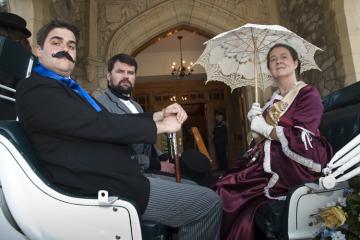
A heritage preservation project that has created a legacy for all British Columbians completed its second phase with the June 22 launch of The Governor’s Letters at Government House by Lieutenant Governor Steven L. Point.
A joint project of the UVic Libraries, the Humanities Computing and Media Centre and the Department of History, The Governor’s Letters is a searchable database of correspondence from the first governors of what would become BC to the Colonial Office in London, England—from 1846 when the colony of Vancouver Island was first conceived to the end of 1857.
When the colonies of Vancouver Island and British Columbia were created, the governors were ordered to report “everything of interest” to the Colonial Office. With several gold rushes, conflicts with Aboriginal people, a near-war with the United States, ships wrecked, treaties signed, murders committed and murderers hanged, towns created and other towns destroyed, the governors were busy getting it all down in the letters, which they called “The Colonial Despatches.”
The project builds upon the work of UVic Historian Dr. Jim Hendrickson (emeritus). Its first phase was launched in 2008 as a prototype comprising despatches relevant to the 1858 Gold Rush. It’s taken a team of faculty, staff and students to transcribe from microfilm, annotate, scan the originals to transcripts, convert the transcripts into a modern database, create curriculum material for students and support materials for teachers. It has been a stellar combination of vision, creativity, technical expertise and collaboration that has brought students, scholars, First Nations and the wider public such easy access to these historically significant documents.
To draw students into the past, The Governor’s Letters is a linked website containing four curriculum challenges designed by teacher-educators and fitting into the grade-5–10 curriculum in BC and across Canada. Students get to use the despatches, as well as other primary sources including maps, paintings, and photographs—all available in both French and English—to analyze the evidence and solve four challenges posed as puzzles: What were the real reasons for creating the Colony of British Columbia? Were the Douglas treaties and the numbered treaties fairly negotiated? Did the Gold Rush radically change daily life in Victoria? Did Governor James Douglas deserve to be knighted?
Phase three of The Colonial Despatches, to be undertaken when resources are found, will bring the entire correspondence up to British Columbia’s confederation with Canada in 1871. You can view The Colonial Despatches from 1846–58 along with all of the early BC maps from the Colonial Office at a publically accessible website. Many maps have been annotated and enriched with links to place name information and date to the colonial period and before.
Photos